Thursday, November 1, 2012

Implementation of Bamboo Wall Panels at the New KONE Center


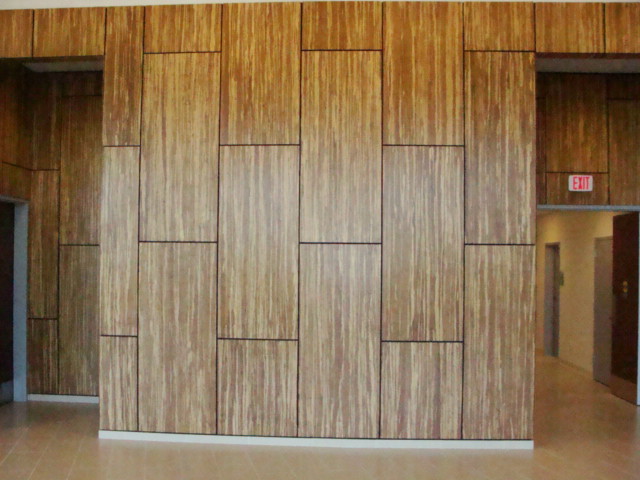
Lamboo, Inc. is pleased to announce the implementation of its products at the new KONE center in Moline, IL. Designers chose to showcase natural materials, specifically the Lamboo® Design™ Series product, Tiger Strand panel. Contemporary design was accomplished with a natural look through the sleek and modern texture of a staggered installation. This particular Tiger Strand wall panel is the adaptation of an aesthetic pattern that accomplishes an innovative look to match the building’s other sustainable design features. “The Lamboo paneling in the lobby provides an aesthetic that you cannot find anywhere in the Quad Cities and this application reinforces the sustainable and cutting-edge image the remainder of the building showcases.” Said Bryce T. Henderson, KONE’s Chief Financial and Operating Officer.


Completed in late summer 2012, the new, mixed-use building will be a significant focal point of architecture in the Quad Cities. The KONE Centre is an eight-story, 121,000-square-feet commercial office and residential condominium building located within Moline’s Bass Street Landing. The functionally designed floor plates are approximately 15,000 square feet at each level. In his new role as Project Manager, Eric Abrams was responsible for estimating, and the coordination of the construction of the new KONE Center in Moline, IL. Commenting on the application of Lamboo Tiger Strand wall panels, Eric stated that “The Lamboo Tiger Strand panel was an excellent choice selected by the Design Architect on the project. The material was within our budget and aesthetically surpassed the expectations of the design team and property owner, it was a homerun product during our value engineering process. The team at Lamboo had excellent product knowledge and was able to assist the design team in selecting the perfect material for our wall panel application. The occupants of KONE Centre are welcomed by nearly 4,500 square-feet of the renewable material, and as the project manager, I could not be more pleased with Lamboo products.”


  For questions regarding Lamboo, Tiger Strand, or to schedule an interview please
visit our website at www.lamboo.us or contact us at info@lamboo.us 866-966-2999

“MAKING INNOVATIVE THINKING A STANDARD” – Lamboo Incorporated

Blog by: Dustin Dennison

Thursday, October 25, 2012

Sustainable Business and Green Building Projects


In an effort to protect the environment, many companies have begun developing sustainable business practices.  By implementing green and sustainable practices, many have found that they can make choices that help the planet as well as their profits. Sustainable business is a relatively new concept for many companies, but it has grown in popularity and use over the past decade and considerable advances are expected for the future.


Sustainable business requirements

Not just any company that chooses to recycle is meeting sustainable business standards. There are certain requirements that must be met in order for a company to be considered part of the green business world.  These include:
  • The business must be considered more environmentally friendly than traditional businesses
  • Sustainability is at the forefront of business decision making
  • An observable commitment to green practices has been implemented across the board
  • Services and products offered from the business are environmentally friendly or meet the public demand for sustainable products.
Because green practices, standards, and demands are always changing, it is important for businesses that employ efforts to stay green to keep up with changing technology.

One area that has been growing even more than others is green building and construction. In many instances, by creating homes, offices, and public buildings that are environmentally friendly, the costs of operating said buildings can be extremely low, and many companies are moving to this form of building.


Green building standards

The United States Green Building Council (USGBC) is the government organization in charge of overseeing the green design and function of buildings across America. By constructing buildings with efficient and supportive designs, the USGBC believes that they can help minimize the energy crisis and create jobs.

The Leadership in Energy and Environmental Design (LEED) concept has changed several aspects of the way green construction and sustainable business practices are run. This international standard is offered as a reward to the building owners who operate their companies within certain standards of excellence in this field. With LEED in mind, many property owners are able to implement sustainable business practices, green construction, efficient building design, and maintain daily operations in an environmentally friendly manner.

Similarly, the United States Business Council for Sustainable Development (US BCSD) is available to help improve environmental awareness within industry, government projects, and business ventures. This non-profit organization is part of a worldwide group of councils that are partnered with the World Business Council for Sustainable Development.  These organizations work across the globe to promote sustainable business initiatives on a worldwide scale, but their impact can be felt locally.

(Read More)

(Excerpt of article by the Triple Pundit. NOT AFFILIATED WITH LAMBOO)


Traditionally, building practices have focused on large scale, low cost production with little regard as to how this could be maintained in the future. This lead to many natural resources becoming strained due to over use and mismanagement. In an era of rising populations and demand for the buildings and structures to support it there becomes the need for not only more efficient building practices but also materials sustainable enough to provide a long term solution. With a maturity rate of 6-8 years (versus 25-50 with timber) Bamboo is just the resource the industry has been searching for. Bamboo is a remarkably strong plant that is not only able to rapidly replenish but also regrows without planting, saving an enormous cost associated with timber in terms of capital and energy.

Additionally, incorporating Lamboo (LVB) laminated veneer bamboo into projects can earn LEED (Leadership in Energy and Environmental Design) certification under MR Credit 6 – Rapidly renewable materials, IEQ Credit 4.4 – Low-emitting materials; ID Credit 1 – Innovation in Design (Environmentally Preferable Material), and ID Credit 2 – Innovation in Design (Life Cycle Assessment / Environmental Impact).

*Please refer to USGBC for information regarding project requirements

For more information about the advantages of Bamboo please visit our sustainability page.


  For questions regarding Lamboo, our products, or to schedule an interview please
visit our website at www.lamboo.us or contact us at info@lamboo.us 866-966-2999

“MAKING INNOVATIVE THINKING A STANDARD” – Lamboo Incorporated
 
Blog by: Dustin Dennison

Tuesday, October 16, 2012

Pier 1 Imports selects high perfomance, sustainable bamboo.

Pier 1 Imports in a mission of promoting quality sustainable facilities has chosen Lamboo materials for refits and new construction of U.S. stores. Lamboo’s laminated veneer bamboo (LVB) will be incorporated into Pier 1 awning and door systems nationwide. With the highly renewable resource of bamboo, Pier 1 is staying environmentally responsible through the use of Lamboo products while ensuring that their stores will not only have long lasting stable systems, but will also stay aesthetically pleasing for their customers.
ImageOne Industries is utilizing the LAMBOO® ELEMENTS™ series in the Pier 1 awnings systems. These exterior grade components and panels feature proprietary manufacturing processes & bonding agents to resist moisture and last throughout harsh environments. These components are on average 20% more stable than hardwoods and up to 40% more stable than softwoods such as pine or douglas fir. Lamboo products attain all low V.O.C. guidelines by LEED (USGBC) and do not produce off-gassing in production or application.

Kolbe Windows & Doors is using material from the LAMBOO® VUE™ series to install long lasting durable door systems for Pier 1. Lamboo, Inc. as the leader in the technologies and manufacturing of performance based engineered bamboo, will be providing these components designed specifically for the window and door systems of Pier 1. Lamboo components have great thermal properties, strength, durability, and contain water resistant attributes that make it ideal for exterior applications.
At this time projects as far west as Alaska to as far east as Florida have already been completed with additional stores planned nationwide.

Lamboo is pleased to work with Pier 1 Imports as well as collaborating with other major retailers and companies that have initiatives to establish strong and environmentally friendly systems.


For questions regarding Lamboo, our products, or to schedule an interview please
visit our website at www.lamboo.us or contact us at info@lamboo.us 866-966-2999

"MAKING INNOVATIVE THINKING A STANDARD" - Lamboo Incorporated


Blog by: Dustin Dennison

Wednesday, October 10, 2012

Stronger bamboo industry pushed for 2016 by DTI

The Department of Trade and Industry pushing for a robust and sustainable Philippine bamboo industry by 2016, its press release said.

The agency is also eyeing to help position the country as a key player in the world bamboo industry next to China by 2020.

The Philippine Bamboo Congress was organized recently to increase public awareness on the potentials of bamboo. By maximizing the use of bamboo in producing products like furniture and construction materials, DTI Undersecretary for Regional Operations and Development Group Merly Cruz said.

The move, Cruz said, aimed to stimulate economic growth and increase job creation, particularly for the marginalized sectors in the countryside, and to contribute in the mitigation of climate change.

By 2016, the DTI targets to create 37,648 jobs and 1,191 micro, small and medium enterprises in the country’s bamboo industry.

It also aims to generate Php744.48 million worth of investments, and P800.1 million in domestic sales from 2012 to 2016.

In 2009, the Philippines was among the top exporters of bamboo products and ranked 6th worldwide with a total export value of $30 million, according to the International Network for Bamboo and Rattan.

(Read More)

(Excerpt of article by the Daily Star. NOT AFFILIATED WITH LAMBOO)


Lamboo Inc. is a innovative company that is leading the trend of sustainable development by utilizing the super material that is bamboo. As the main provider of structural grade bamboo, Lamboo is committed to cultivating this material to its full potential for use as a replacement to the traditional and depleted sources of timber as a ultra renewable alternative. Bamboo is not only a rapidly renewable resource in the form of engineered LVB (Laminated Veneer Bamboo) but also features performance attributes far greater than any other plant species. Superior performance, rapid replenishment, and environmental benefits make bamboo the ideal building material.
 
 For questions regarding Lamboo, our products, or to schedule an interview please
visit our website at www.lamboo.us or contact us at info@lamboo.us 866-966-2999

“MAKING INNOVATIVE THINKING A STANDARD” – Lamboo Incorporated


Blog by: Dustin Dennison

Monday, October 8, 2012

Nigeria Can Generate 24 Million Jobs From Bamboo Production

Director of Forestry Department Ministry of Environment, Mr John Auta, has said that Nigeria can generate N28.6bn annually from bamboo production as well as create over 24 million jobs.

He said the management of bamboo forest would generate large-scale employment through harvesting, collection, transportation, storage, processing, utilization and marketing of products which would be replicated in Nigeria.

Speaking to LEADERSHIP at the weekend, he said: “The comparative advantage for Nigeria to adopt bamboo as tool for employment generation and rural development is not in doubt, because of the large pool of unemployed youths. With this, over 24 million jobs can be created and the country can get to generate N28.6bn annually too.

"The availability of indigenous bamboo species that would thrive well even in poor or degraded soil in many parts of the country is another advantage to Nigeria.”


He also advised Nigerians to commence the propagation of Bamboo to reduce overbearing demand on timber products, adding that dependence on timber had posed a serious threat to timber production.

He said the department was already reaching out to relevant bodies to achieve the goal of cultivating bamboo and other non timber products and added that the Nigerian forests were lying fallow, waiting to be explored in areas that would positively affect the people.

He said: “Nigeria is blessed with bamboo resources which grow on both private and state forest lands in all the southern rain forest states up to some derived savanna states in the North-central states of Nigeria.

“Bamboo has high potential for contributions to achieving sustainable forest management when it is optimally and efficiently utilized for producing substitutes for wood production and increases incomes for rural lively hoods,” he said.

He announced that Nigeria became a member of the International Network for Bamboo and rattan (INBAR) to actualize the goal of achieving the bamboo production in the country.

According to him, the United Nations Industrial Development Organization (UNIDO) had undertaken a project formulation mission for the development of project proposal on bamboo and rattan processing in Nigeria.

He said the purpose of the project was to promote the development of bamboo and rattan value chain in West Africa.

(Read More)

(Excerpt of article by Leadership. NOT AFFILIATED WITH LAMBOO)


Environmental and social concerns have initiated international efforts to search for and create sustainable methods in our society. With declining resources and increasing populations there is the need for new materials for building and of course more opportunities for employment. It is clear that bamboo can be that renewable resource to be used in the next era of architecture and product development. Much like all natural resources bamboo must be protected and preserved as it is the most plausible solution to replace diminishing supplies of timber. Lamboo, Inc. is working closely with both private and government agencies internationally to ensure that bamboo resources are managed properly so that this remarkable resource will be there for the future.

  For questions regarding Lamboo, our products, or to schedule an interview please
visit our website at www.lamboo.us or contact us at info@lamboo.us 866-966-2999

"MAKING INNOVATIVE THINKING A STANDARD" - Lamboo Incorporated


Blog by: Dustin Dennison

Wednesday, October 3, 2012

Success at ASLA 2012 in Phoenix!

The 2012 ASLA annual meeting & expo has came to a close, but the progress made there will last for years to come. At the show more than 375 companies showcased the latest innovative landscape products and projects many of which based on sustainable practices and renewable materials. Lamboo, Inc. was among the companies represented at the show in the Phoenix Convention Center which introduced us to many like minded architects and organizations in the field.


In addition to meeting architects and manufacturers there was great interest in integrating the ultra renewable resource of bamboo in various municipalities throughout the U.S. including New York City parks. It was apparent at the show that many designers and planners are searching for a sustainable alternative to traditional materials that can also perform exceptionally well in the elements but haven't had much success until now. Many of these individuals had heard of bamboo's potential but were unaware of it's availability for their applications previously.


Showcased at the booth were structural beams fabricated by G.R. Plume, curtain wall members from Dover, handrails from Gerber, as well as a trash receptacle and bench from Landmark Studio & Design. Lamboo would just like the thank these partners again for their great work and commitment to sustainability.


For additional information about the 2012 ASLA show or Lamboo materials please contact us at 866-966-2999 or info@lamboo.us


“MAKING INNOVATIVE THINKING A STANDARD” – Lamboo Incorporated

Blog by: Dustin Dennison

Monday, September 24, 2012

ASLA Annual Meeting & Expo 2012

Lamboo representatives will be attending the 2012 ASLA annual meeting & expo in Phoenix September 28th – October 1st to showcase the Lamboo® Elements™ product line and answer any questions attendees may have.

Founded in 1899, the American Society of Landscape Architects is the national professional association representing landscape architects. Beginning with 11 original members, ASLA has grown to 15,428 members (as of December 31, 2011). ASLA promotes the profession and advances its practice through advocacy, education, communication, and fellowship. In addition, stewardship of the land has always served a central role in the mission of the ASLA and is an integral element of all outreach.

“The Society's mission is to lead, to educate, and to participate in the careful stewardship, wise planning, and artful design of our cultural and natural environments.”

The Lamboo® Elements™ series is composed of exterior grade laminated veneer bamboo (LVB) designed for exterior finish and landscape applications. The Elements™ series offers strength, rigidity, and is capable of replacing traditional hardwoods in nearly any application. Lamboo materials in comparison to engineered wood are 20% more stable in climate and temperature changes enabling our products to perform exceptionally in harsh environments and remain functional for much longer than traditional wood products.

Lamboo will be showcasing applications of the material in the landscape market by displaying a trash receptacle and park bench provided by Landmark Studio & Design. Landmark is a Midwest U.S. based company that provides high quality products for educational, residential, commercial, and hospitality markets including parks, resorts and marinas. In partnering with Lamboo, Landmark has made a commitment to sustainability by offering the ultra-renewable resource of Lamboo engineered bamboo within their product lines.

The Lamboo booth will be located at space #1277 near the main food court.


 For additional information about Landmark products available with Lamboo materials please contact:

Chad Schaefer
National Sales Manager
(888) 839-3853 | Toll-Free Office
(262) 257-9301 | Direct Office
(262) 391-4552 | Mobile
chad@landmarkstudio.com


“MAKING INNOVATIVE THINKING A STANDARD” – Lamboo Incorporated

Blog by: Dustin Dennison

Monday, September 17, 2012

Bamboo goes commercial

Jamaica is now set to enter bamboo production on a commercial basis, having gained entry as the 38th member to the International Network for Bamboo and Rattan (INBAR).
Jamaica already produces furniture and household items from bamboo, much of which is done by informal craft traders, but the new program is meant to devise more hardy and quality products.

The plant grows prolifically throughout Jamaica.

Gladstone Rose, chairman of the Bamboo industry Advisory Committee at the Bureau of Standards Jamaica (BSJ), said Thursday that INBAR membership gives Jamaica access to technology transfer models and other documents that the agency can use to guide private companies to develop bamboo prototypes.

The prototypes include bamboo plywood, bamboo tiles, bamboo board, bamboo students chairs and other engineered bamboo products using the most prolific local variety of bamboo, Bambusa vulgaris.

"The team has successfully produced bamboo products prototypes but now seek venture capital to supply already identified markets locally and in the United States of America," Rose told Sunday Business.

The BSJ work is focused initially on Glengoffe, where training sessions using the INBAR material has been under way since April. The workshops will span two years.

INBAR is an intergovernmental organization headquartered in China, comprising countries that have bamboo or rattan resources in quantities that can be commercialized.

Through its network of member countries, organizations and individuals from all continents of the world, INBAR develops and assists in the transfer of appropriate technologies and solutions to benefit the peoples of the world and their environment," said Rose.

"Information on 122 Chinese bamboo and rattan products/process standards have been received which will help the BSJ and bamboo products producers rapidly develop Jamaican standards and ultimately create a modern standards-led bamboo products industry," he said.

The BSJ earlier this year was designated by the Ministry of Industry Investment and Commerce to be the focal point for INBAR in Jamaica.

"The Government of Jamaica recognizes that bamboo is a valuable renewable resource which grows rapidly and therefore is a good substitute source for wood instead of timber, obtained by cutting down trees which takes on average 40 years to grow to maturity," Rose said.

The Bamboo Industry Advisory Committee, which he heads, was set up by the BSJ to oversee the development of pilot projects, studies and product prototypes.

The committee also plans to publish its own guidance documents for use of the new bamboo industry that Jamaica expects to emerge from the INBAR project.

"Such documents will prescribe standards, policies and ethical practices for the industry," Rose said.

The standards-led industry is to be developed over a two-year period. The project incorporates entities such as the state-run Forestry Department and the Jamaica Wood Products and Furniture Association representing private operators.

Rose said bamboo manufactured products will include school furniture, including desks and chairs, while bamboo plywood will be used to make doors, skirting and moldings.

Bamboo was first introduced in Jamaica to strengthen riverbanks. A Forestry Department count in 2000 found that the plant covered more than 44,000 hectares nationwide. Today, Rose says there are 47,000 hectares of bamboo growing wild.

Around 1999-2000, according to the Lewis-Nelson paper, the Forestry Department, backed by private sponsorship, imported and erected a "bamboo-concrete house" using material and technical resources from Costa Rica.

"It generated much interest from a wide variety of persons, groups and institutions, but has not realized the desired effect of utilizing local bamboo for low-cost housing on a large scale," the paper said.

Market leader China has developed its bamboo industry into a US $14-billion enterprise, of which US $2-billion worth of products is exported to the West, according to Rose.

"The value of Jamaican manufacture is minuscule by comparison," said the BSJ executive. "We are trying to create a new industry."

(Read More)

(Excerpt of article by Avia Collinder, of The Gleaner. NOT AFFILIATED WITH LAMBOO) 

Lamboo is a manufacturer of laminated veneer bamboo (LVB) for structural and interior design applications. Lamboo can be utilized in a variety of products and systems from window & door units, curtain wall systems, industrial shipping containers to table tops and yacht interiors. Lamboo materials can be used as a substitute to traditional wood in nearly every application as a rapidly renewable and sustainable alternative. The strength of bamboo has lead to it being referred to as ‘vegetable steel’ with a tensile strength of 28,000 per square inch.

Bamboo has long been revered for its enormous potential as a building product but is only now starting to be fully utilized. That is something very exciting and will play a huge role in the future.


For questions regarding Lamboo, our products, or to schedule an interview please
visit our website at www.lamboo.us or contact us at info@lamboo.us 866-966-2999

“MAKING INNOVATIVE THINKING A STANDARD” – Lamboo Incorporated

Blog by: Dustin Dennison
Tuesday, September 11, 2012

Powering Sustainability with the World’s First Bamboo Tender Introducing the LAMBOO Tender R1

A few weeks ago Lamboo announced the design of the world’s first tender incorporating the rapidly renewable resource of bamboo, the Lamboo® Tender R1. With the Monaco Yacht Show 2012 less than two weeks away Lamboo is providing additional details on the design for individuals involved in the maritime industry and those who will be attending the show and would like to discuss the project further.

The Lamboo® Tender R1 is a revolutionary design from Sigmund Yacht Design, a leading yacht and tender design firm which has chosen Lamboo materials not only for the sustainable attributes of bamboo but for its superior performance over traditional forms of hardwood. Also included in the design is a Steyr hybrid turbo diesel engine as well as state of the art navigation, electrical, and LED lighting systems.


“This showcase is a key example of both companies’ commitment to integration of environmentally responsible methods matched with innovative engineering of performance materials into the nautical market”
said Luke Schuette, Lamboo Founder/CEO.

The construction of the R1 is being carried out by Cockwells, a pioneer within yacht and tender fabrication specializing in advanced engineering and modern construction techniques.

Executives from all three companies will be in attendance at the 2012 Monaco show and will be available for discussion on the R1 and the integration of sustainable bamboo materials within the maritime industry.

(Read full release on PRWeb)


For questions regarding Lamboo, our products, or to schedule an interview please
visit our website at www.lamboo.us or contact us at info@lamboo.us 866-966-2999

“MAKING INNOVATIVE THINKING A STANDARD” – Lamboo Incorporated

Blog by: Dustin Dennison

Tuesday, September 4, 2012

In Africa’s Vanishing Forests, the Benefits of Bamboo

In the district of Asosa, the land is thick with bamboo. People plant it and manage the forests. They rely on its soil-grabbing roots to stabilize steep slopes and riverbanks, cutting erosion. They harvest it to burn for fuel, to make into charcoal sticks to sell to city dwellers and to build furniture.

Asosa is not in China, not even in Asia. It is a district in the west of Ethiopia, on the Sudanese border. To many people, bamboo means China. But it’s not just panda food — mountain gorillas in Rwanda also live on bamboo. About 4 percent of Africa’s forest cover is bamboo.

Soon it may be much more. Bamboo may provide a solution to a very serious problem: deforestation. In sub-Saharan Africa, 70 percent of the people cook their meals over wood fires. The very poorest cut down trees for cooking fuel; those slightly less poor buy charcoal made from wood in those same forests. Every year Africa loses forest cover equal to the size of Switzerland. Terence Sunderland, a senior scientist at the Indonesia-based Center for International Forestry Research, said that in southern Africa, even trees that can be used for fine carving, such as ebony and rosewood, are being cut down and made into charcoal.

Deforestation starts a vicious circle of drought and environmental decline. Burning wood releases the carbon stored inside. And deforestation accounts for at least a fifth of all carbon emissions globally. As tree cover vanishes, the land dries out and the soil erodes and becomes barren — a major reason for Ethiopia’s periodic famines.

Hundimo Dedere owns and manages a plantation of African highland bamboo in Southern
Ethiopia that was used as a model for modern bamboo cultivation and management training.
 
 How does bamboo improve on hardwood? Cut down a hardwood tree and it’s gone. It will take several decades for another to grow in its place; it can take a century for a forest to grow back after cutting. But bamboo is a grass, not a tree. Under the right conditions, it can grow a full meter a day — you can literally watch it grow. It is also fast maturing. A new bamboo plant is mature enough to harvest after three to six years, depending on the species. Most important, bamboo is renewable. Unlike hardwood trees, bamboo regrows after harvesting, just as grass regrows after cutting. After it is mature, bamboo can be harvested every single year for the life of the plant.

Bamboo has other advantages. Its roots grab onto soil and hold it fast. Plant bamboo on a steep slope or riverbank and it prevents mudslides and erosion. And bamboo is parsimonious with Africa’s most precious resource: water.

“In Africa you want everything,” said Dr. Chin Ong, a retired professor of environmental science at the University of Nottingham in England, who was formerly a senior scientist at the World Agroforestry Center in Nairobi. “You want firewood, you want to reduce erosion, to maintain the water supply, generate cash and employment. Bamboo comes the closest — it gives you the most things.”

In the last five years or so, Ong said, Ethiopia has realized that bamboo is a more profitable and greener solution. INBAR’s program is a four-year project financed by the European Commission and the Common Fund for Commodities, a United Nations organization. The technology comes from China. The project provides bamboo seedlings and trains people to manage bamboo plantations.

Because bamboo requires few nutrients, it can grow in soil inhospitable to other plants — not only does it thrive there, it can reclaim the land so other plants can thrive, too. Its roots leach heavy metals from the soil, hold the soil together and draw water closer to the surface. One example is a project in Allahabad, India, to reclaim land whose topsoil had been depleted by the brick industry. In 1996, an INBAR project planted the land with bamboo. Five years later, villagers could farm the land again. Dust storms — a local scourge — were greatly reduced. The bamboo also helped raise the water table by seven meters. In 2007, the project won the global Alcan Prize for Sustainability.

Bamboo's tensile strength makes it a good construction material, and it is also used for furniture, flooring and textiles, among other things.

In some ways, the challenge in Africa is not to introduce bamboo, but to persuade people and governments that it has commercial uses. “We’ve taken policymakers from Africa to China and India where bamboo used in everyday life — and there’s still very poor adoption,” said Ong.

(Read More)

(Excerpt of article by Tina Rosenberg of the New York Times. NOT AFFILIATED WITH LAMBOO) 
 
  
Lamboo strives to protect and promote this remarkable resource by working with various international organizations to ensure that the bamboo used in our products is sourced from responsibly managed bamboo plantations and nurseries. Additionally all bamboo used for Lamboo products come from a select list of bamboo species that is not used as a food source by wildlife. If you want to learn more about Lamboo’s commitment to sustainability, please contact us here.

For questions regarding Lamboo, our products, or to schedule an interview please
visit our website at www.lamboo.us or contact us at info@lamboo.us 866-966-2999

“MAKING INNOVATIVE THINKING A STANDARD” – Lamboo Incorporated

Blog by: Dustin Dennison