Showing posts with label sustainability. Show all posts

Tuesday, November 11, 2014

New Site for Interior Design Millwork Products and Solutions


Lamboo, Inc. invites everyone to visit our new interior design and millwork site for your product integration needs. This new site was designed to allow our valued clients and customers to more easily access our interior millwork solutions through the integration of panels, veneer, and components. This ultra-simplified and streamlined site also allows for ease of specification and understanding of the products, applications, and solutions. This site will appeal to architects, engineers, and design professionals whom appreciate the performance, sustainability, and aesthetics and the multifaceted characteristics that our Lamboo® Design™ series of products have to offer.  Please direct any inquiries for Lamboo® Design™ via our new product website here! For more information about Lamboo® material technologies, please email us at info@lamboo.us.


Thursday, October 3, 2013

Lamboo Features in Springfield Business Journal


 “Sustainability” has become a buzzword of the 21st Century. Organizations are reducing their footprint with recycling policies and encouraging employees to carpool or use public transportation. Today it is de rigueur to receive an email with part of the signature line including a demand to “think before you print!” Legislation and regulations are brimming with encouragement, in some cases, and mandates, in others, to build as cleanly as possible with energy efficient materials. A number of projects in and around Springfield have bragged about the achievement of LEEDs Certification for their new buildings in recent years. (Before you hit Google, LEED stands for Leadership in Energy and Environmental Design.)

A company in Springfield is at the leading edge of introducing a sustainable raw material – bamboo – to the market with diverse applications and enormous growth potential. Lamboo, Inc. started with the intent of developing a product that satisfies the need for sustainability in the 21st Century while also providing a material that spans a range of applications and exceeds expectations of more traditional materials.

By way of introduction, bamboo holds the promise of being the sustainability wunderkind of the 21st Century when compared with traditional materials such as wood, steel and aluminum for the following reasons. Bamboo produces approximately 14 tons of fiber per acre every six to eight years or six times that of timber, which takes 25-30 years to mature. Bamboo can be harvested without replanting and the silica content makes the plant resistant to insect infestation. Bamboo sequesters about 35 percent more carbon than timber, has natural anti-microbial properties and a root structure that helps to eliminate soil erosion.

Lamboo, Inc. has developed and brought to market a new bamboo product – Laminated Veneer Bamboo (LBV).“We are truly leading an industrial materials revolution,” said Luke D. Schuette, President & Founder, Lamboo, Inc. As an architecture student at Southern Illinois University, Schuette became interested in and began testing various materials for strength, flexibility and sustainability.

“I ended up paying for my own testing at a St. Louis lab in order to determine if the product was going to be sufficient,” Schuette said, explaining the start-up process for Lamboo, Inc.

Laminated bamboo veneer was an idea so ahead of the curve that an American Society for Testing and Materials (ASTM) category or standards did not exist prior to 2007. Schuette and his team presented LBV to ASTM in 2007 and were awarded a new category and standards to compare LBV to other construction and design materials. Since Lamboo, Inc. has achieved the certification, the company has grown to a worldwide presence receiving a 2013 Governor’s Export Award for increasing their export market 63 percent from 2011 to 2012.

Lamboo, Inc. has four broad market categories that it intends to exploit – Architectural/Structural/High Performance Buildings, Aviation/Maritime/Automotive, Design and Industrial. “Lamboo, Inc. makes a laminated veneer product that is lighter and stronger than many traditional products,” Schuette noted. “Lamboo, Inc. is not designing office desks or guitars or commercial beams. We are partnering with companies around the world who desire a sustainable material.”

Products that Lamboo has been involved with include laminated structural beams, architectural elements such as louvers and awnings and window and door systems. Important for designers, architects and builders, no other raw material receives as many LEED points as LBV. Given LBV’s strength and light weight properties it is also a good fit for veneer applications for plane, yacht and car finishes. A tour around the Laboo office also identified some partnerships in the form of a prototype electric guitar, rifle stock and chandelier parts.

Schuette located Lamboo, Inc. in Springfield purposefully. The high quality of life and low cost of living played a large role in looking at Springfield. “Although we have partners around the world and we travel quite a bit, much of our business is conducted via email and Skype,” Schuette said. In fact, the company has brought partners to the Capitol City to experience what Springfield has to offer in hopes of generating further synergy for Lamboo’s products and business plan.

Sustainability in our daily lives is here for the long haul. Buildings and products will continue to seek new and innovative materials that retain and enhance the role traditional materials but with an edge on energy efficiency and environmental stewardship. Lamboo, Inc. is leading a revolution in sustainable materials from its perch overlooking the Old State Capitol. Luke Schuette and Lamboo, Inc. have made great strides and have plans for continued growth in Springfield, Central Illinois and the world.


(Excerpt of article by David A. Kelm. NOT AFFILIATED WITH LAMBOO)


Wednesday, April 17, 2013

“Green” Building Construction Rises in U.S.

Taking the “LEED”

in Green Buildings In 2000, the Albanese Organization was chosen to develop the first “green” high-rise residential tower in the United States. Called The Solaire, it was the first high-rise residential project to receive Leadership in Energy and Environmental Design (LEED) Gold Certification from the U.S. Green Building Council. LEED certifications is a widely recognized third-party verification that a building is environmentally friendly. Subsequently, Albanese developed three more LEED Certified buildings in Manhattan, The Visionaire, The Verdesian, and The Vanguard Chelsea.

Now comes The Living Building Challenge (LBC). The Living Building Challenge is a green building certification program that defines the most advanced measure of sustainability in the built environment possible today. Projects that achieve this level of performance can claim to be the ‘greenest’ anywhere. The LBC requirements go beyond those of a LEED certification. The LBC uses a vetting process to avoid some of the pitfalls suffered by various LEED certified buildings, where “efficient” structures have proven to be less than advertised after completion and energy audits.

One building that is attempting to qualify for the LBC is the newly constructed Bullit Center in Seattle, WA. Qualifying is no small feat: The Living Building Challenge has 143 registered projects in 10 countries, but only three buildings in the United States have been fully certified so far; the largest of those is an eighth the size of the Bullitt Center.

The Living Building Challenge requires a project to meet 20 specific imperatives within seven performance areas (or “Petals”). For the Bullitt Center, meeting the imperatives will include the following:

The location will support a pedestrian-, bicycle-, and transit-friendly lifestyle. Rainwater will be collected on the roof, stored in an underground cistern and used throughout the building. A solar array will generate as much electricity as the building uses. The building will not contain any “Red List” hazardous materials, including PVC, cadmium, lead, mercury and hormone-mimicking substances, all commonly found in building components. The lifespan of The Bullit Center is projected to be 250 years. The building officially opens on April 22; Earth Day.

Dennis Hays, the president of The Bullitt Foundation, said “The Bullitt Center will be the first office building in the United States to capture rain water, store it and purify it, and then use it for potable drinking water. We will use rain water in our coffee, our dishwaters, our showers, and for everything else. We will filter the resulting gray water and infiltrate it into rain gardens full of vegetation in front of our building. We will make no use of Seattle public water supply.” To help protect Puget Sound, rainwater will be retained on site and “grey water” from sinks in the building will be filtered through a green roof.”

  Bullit Center in Seattle, WA

Other Green initiatives 

The University of North Texas built a state-of-the-art Zero Energy Research Laboratory, where students and faculty will get first-hand experience with sustainable energy technologies. The facility is designed to test emerging technologies that allow building systems to have a net-zero consumption of energy. The UNT ‘Zero House’ uses Benchmark wall panels because they cut the electric load by one half to two thirds. Initially, the facility was powered by solar energy.

“Two faculty members, 6 graduate students and one post-doctoral research associate are working in ZØE research group at UNT,” explained Rambod Rayegan, a Visiting Assistant Professor in the mechanical and energy engineering department. “The research group is currently focused on integrated simulation and verification of the building and its sub systems, air flow and heat transfer analysis of solar chimney, human behavior factors sensitivity and uncertainty in energy modeling of the building, multiyear modeling of the ground loop heat exchanger, and design a novel thermal energy storage system to achieve the maximum utilization of solar power.”

Dr. Yong Tao, chair of the Department of Mechanical and Energy Engineering and PACCAR Professor of Engineering at UNT, and a committee of experts oversaw the design of the lab. Tao is an internationally known researcher in fundamentals of thermal sciences, refrigeration system performance and renewable energy applications in buildings. He joined the UNT faculty in the fall of 2010. Tao also served as the director of the Future House USA project, an initiative that brought together academics, builders, industry sponsors and lobbyists to create a 3,200 square-foot zero-net energy house that was built in Beijing for the 2008 Olympic Games.

(Read More)

(Excerpt of article from Azobuild. NOT AFFILIATED WITH LAMBOO)

Lamboo, Laminated Veneer Bamboo (LVB), designed from one the most rapidly renewable plant species on the planet, bamboo, has the potential to be integrated in this new wave of "Green" buildings. Lamboo can be used to replace less sustainable materials in nearly any conceivable application from curtain wall systems to office furniture. Additionally use of Lamboo materials can receive accreditation from building codes such as LEED from the USBC on qualifying projects.

LEED Credits available through Lamboo integration

  • MR Credit 6 - Rapidly renewable materials
  • IEQ Credit 4.4 - Low-emitting materials
  • ID Credit 1 - Innovation in Design
    (Environmentally Preferable Material)
  • ID Credit 2 - Innovation in Design
    (Life Cycle Assessment / Environmental Impact)
  • FSC Certification - Available Upon Request
 

Learn more about Lamboo

What is Lamboo?
Certifications

Product Information

Research
Structural1Divider_2Curtain1Divider_2w_and_d1Divider_2interiors1Divider_2exteriors1Divider_2aviation_1
Continue reading
 
For questions regarding Lamboo or our products please visit our website
at www.lamboo.us or contact us at info@lamboo.us 866-966-2999

“MAKING INNOVATIVE THINKING A STANDARD” – Lamboo Incorporated


Blog by: Dustin Dennison 

Tuesday, March 12, 2013

WORLDBEX - The Philippine World Building and Construction Exposition


For more than a decade, WORLDBEX or The Philippine World Building and Construction Exposition has been a haven for the local and international building and construction industry, supported by acknowledged sectors of society and a visitor profile of more than 150,000 per year, it is dubbed to be Asia’s most attended construction exposition.

WORLDBEX holds a good number of global ties with countries such as Austria, Australia, Belgium, Brunei, China, Finland, Hong Kong, the U.S. and Germany to name a few of the 25 participating countries, it is an ideal venue for business transactions and introduction of innovations.

WORLDBEX is known for putting together over 500 exhibiting companies and more than a thousand booths in a Wi-Fi ready exhibit area of 30,000 sq/m. These companies range from building materials equipment services, construction design and development, architects and interior designers, and leading manufacturers and furniture exporters. WORLDBEX will also showcase the top colleges and universities in inter-school interior design competition and include the biggest names in the local and international building and construction scene for seminars.

At the show Lamboo will be showcasing the world's most renewable and sustainable construction material, Laminated Veneer Bamboo (LVB), a high performance bamboo product. Representatives will be at booth #S55-S56 to answer any questions attendees may have and to discuss the attributes that make Lamboo a superior product for the construction industry.

To learn more please visit our Sustainability, Research, or Certifications pages. Please visit our Resource Library for product details and specifications!

To remain updated on the latest with Lamboo and the sustainable construction industry please subscribe to this blog via the link at the top right hand corner of this page!


For questions regarding Lamboo or our products please visit our website
at www.lamboo.us or contact us at info@lamboo.us 866-966-2999

“MAKING INNOVATIVE THINKING A STANDARD” – Lamboo Incorporated


Wednesday, December 19, 2012

The Evolution of Green Construction

The homes we live in create a huge carbon debt before the proud new owners ever cross the threshold. But even worse is the fact that they are built in such a way that they will continue to do harm once they are inhabited, thanks to inadequate insulation that leaves homeowners cranking the heat and AC, not to mention a complete lack of sustainable energy options. Luckily, there is a bright spot on the horizon, and it comes in the form of green construction.

The average construction site could be described as less than eco-friendly, to put it mildly. The materials used for such projects often include natural resources like wood and stone that are not harvested in a sustainable manner. Both logging and mining operations are notorious for damaging the environment through their efforts and doing very little to clean up afterwards. Further, these materials are frequently shipped all over the globe, creating massive amounts of pollution along every step of the way, not to mention the manufacturing processes, which produce even more pollution and waste.

And then, of course, there is the construction itself, which continues this assault on the environment. In short, the homes we live in create a huge carbon debt before the proud new owners ever cross the threshold. But even worse is the fact that they are built in such a way that they will continue to do harm once they are inhabited, thanks to inadequate insulation that leaves homeowners cranking the heat and AC, not to mention a complete lack of sustainable energy options. Luckily, there is a bright spot on the horizon, and it comes in the form of green construction.

Over the last several years, a rapidly growing awareness of serious environmental issues (pollution, deforestation, global warming, habitat loss, species extinction, etc.) has led the public to call for alternatives to the products and services they use on a daily basis. And since many consumers start in the home, the demand for green options on this front has grown considerably. In response, the construction industry has begun to realize a shift in practices, not as a whole, but at least in part, with companies springing up that provide eco-friendly options in the building process.

(Read More)

(Excerpt of article by EcoCltr.)


Environmental concerns have initiated efforts by organizations of all kinds from the private or public sector as well as government bodies to develop renewable practices and materials to replace declining or unsustainable resources. Bamboo as a resource is unmatched in its potential as an environmentally friendly, structurally stable building material. Bamboo produces 30% more oxygen and sequesters 35% more carbon than a like sized timber forest area. With a growth rate of 6-8 years to maturity (compared to timber 25-50) and root structure that eliminates the need for replanting bamboo can be produced on a large scale with much more ease than timber forests cutting costs and limiting energy consumption. Lamboo’s LVB (Laminated Veneer Bamboo) also represents one of the highest performing building materials available to the industry. Learn more about Lamboo’s attributes here.

For questions regarding Lamboo or our products please visit our website
at www.lamboo.us or contact us at info@lamboo.us 866-966-2999

“MAKING INNOVATIVE THINKING A STANDARD” – Lamboo Incorporated

Blog by: Dustin Dennison

Thursday, December 6, 2012

USGBC launches Green Building Information Gateway

The U.S. Green Building Council (USGBC) has announced the launch of the Green Building Information Gateway. Coined GBIG, the web-based tool will accelerate market transformation by providing greater transparency and understanding of the green dimensions of the built environment. 

GBIG provides a transparent view of places, projects, collections and credits, detailing the actions and activities of LEED building owners and project teams over time. The tool provides maps, analytics and insights that reveal trends, patterns and processes in green building practice.

GBIG seeks to use data-driven insights to create value and competitive advantage for high performing green building projects around the world, the green building council said.

“The launch of GBIG represents years of research, information gathering and testing, and has been a true labour of love,” said Chris Pyke, the council’s vice-president, research. “Green building has gone from an era of firsts, to a global movement, connected by data.”

Users can search and explore green building activity around the world, analyze trends and patterns in green building practice and discover connections between projects, people, products and services. Additional information is available at: GBIG.org.

The tool was launched at the Greenbuild International Conference & Expo in San Francisco.

(Read More)

(Excerpt of article by Daily Commercial News. NOT AFFILIATED WITH LAMBOO)

Incorporating Lamboo (LVB) Laminated Veneer Bamboo into projects can earn LEED (Leadership in Energy and Environmental Design) certification under MR Credit 6 – Rapidly renewable materials, IEQ Credit 4.4 – Low-emitting materials; ID Credit 1 – Innovation in Design (Environmentally Preferable Material), and ID Credit 2 – Innovation in Design (Life Cycle Assessment / Environmental Impact). *Please refer to USGBC for information regarding project requirements.

For questions regarding Lamboo, our products, or to schedule an interview please
visit our website at www.lamboo.us or contact us at info@lamboo.us 866-966-2999

“MAKING INNOVATIVE THINKING A STANDARD” – Lamboo Incorporated
Blog by: Dustin Dennison


Thursday, November 8, 2012

Sustainable Materials for Curtain Wall Innovations

Lamboo Inc. has integrated the most sustainable natural resource, bamboo, into curtain wall members and storefront system components.


Lamboo’s Renewall™ series is ideal for both residential and commercial applications bringing warmth and longevity to each project while exceeding aluminum system’s performance through longer unsupported spans, higher fire rating, and thermal performance. Renewall™ systems can easily be integrated into innovative projects large and small while meeting Passive House Standards.

The Split Mullion Design allows for easy integration of Lamboo materials with aluminum coverings for many applications from storefronts, curtain walls, and conservatories. The coupling mullion pre-fabricated frames can be finished in the fabrication shop with base profiles, interior gaskets and glass supports. Installation on site, these frames are simply coupled, glazed, and finished with pressure profiles. Incorporating Lamboo® Renewall™ materials give systems unmatched qualities including aesthetics, thermal properties, and ease of integration while obtaining optimum variability within harsh and changing environments.


Lamboo, Inc. is leading the way of sustainable building materials and products by innovative industrialization of bamboo. As an ultra-renewable alternative to traditional materials Lamboo, LVB (Laminated Veneer Bamboo), features performance attributes far greater than other building materials such as timber, aluminum or fiber glass. Superior performance, rapid bamboo replenishment, and environmental benefits make Lamboo the ideal building material for project showcases worldwide.

  For questions regarding Lamboo, our products, or to schedule an interview please
visit our website at www.lamboo.us or contact us at info@lamboo.us 866-966-2999

“MAKING INNOVATIVE THINKING A STANDARD” – Lamboo Incorporated
 
Blog by: Dustin Dennison

Thursday, November 1, 2012

Implementation of Bamboo Wall Panels at the New KONE Center


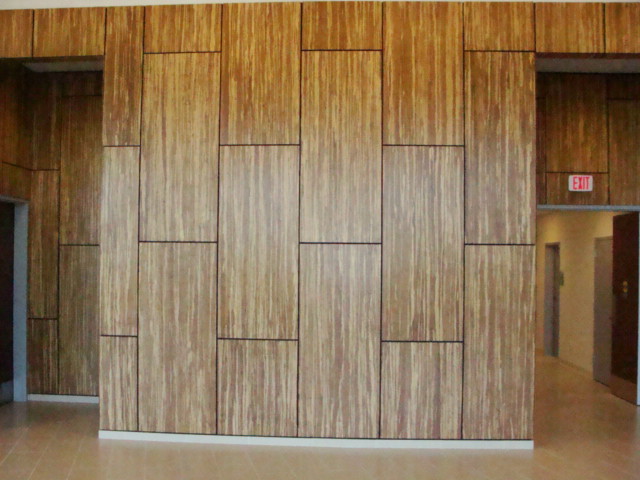
Lamboo, Inc. is pleased to announce the implementation of its products at the new KONE center in Moline, IL. Designers chose to showcase natural materials, specifically the Lamboo® Design™ Series product, Tiger Strand panel. Contemporary design was accomplished with a natural look through the sleek and modern texture of a staggered installation. This particular Tiger Strand wall panel is the adaptation of an aesthetic pattern that accomplishes an innovative look to match the building’s other sustainable design features. “The Lamboo paneling in the lobby provides an aesthetic that you cannot find anywhere in the Quad Cities and this application reinforces the sustainable and cutting-edge image the remainder of the building showcases.” Said Bryce T. Henderson, KONE’s Chief Financial and Operating Officer.


Completed in late summer 2012, the new, mixed-use building will be a significant focal point of architecture in the Quad Cities. The KONE Centre is an eight-story, 121,000-square-feet commercial office and residential condominium building located within Moline’s Bass Street Landing. The functionally designed floor plates are approximately 15,000 square feet at each level. In his new role as Project Manager, Eric Abrams was responsible for estimating, and the coordination of the construction of the new KONE Center in Moline, IL. Commenting on the application of Lamboo Tiger Strand wall panels, Eric stated that “The Lamboo Tiger Strand panel was an excellent choice selected by the Design Architect on the project. The material was within our budget and aesthetically surpassed the expectations of the design team and property owner, it was a homerun product during our value engineering process. The team at Lamboo had excellent product knowledge and was able to assist the design team in selecting the perfect material for our wall panel application. The occupants of KONE Centre are welcomed by nearly 4,500 square-feet of the renewable material, and as the project manager, I could not be more pleased with Lamboo products.”


  For questions regarding Lamboo, Tiger Strand, or to schedule an interview please
visit our website at www.lamboo.us or contact us at info@lamboo.us 866-966-2999

“MAKING INNOVATIVE THINKING A STANDARD” – Lamboo Incorporated

Blog by: Dustin Dennison

Tuesday, October 16, 2012

Pier 1 Imports selects high perfomance, sustainable bamboo.

Pier 1 Imports in a mission of promoting quality sustainable facilities has chosen Lamboo materials for refits and new construction of U.S. stores. Lamboo’s laminated veneer bamboo (LVB) will be incorporated into Pier 1 awning and door systems nationwide. With the highly renewable resource of bamboo, Pier 1 is staying environmentally responsible through the use of Lamboo products while ensuring that their stores will not only have long lasting stable systems, but will also stay aesthetically pleasing for their customers.
ImageOne Industries is utilizing the LAMBOO® ELEMENTS™ series in the Pier 1 awnings systems. These exterior grade components and panels feature proprietary manufacturing processes & bonding agents to resist moisture and last throughout harsh environments. These components are on average 20% more stable than hardwoods and up to 40% more stable than softwoods such as pine or douglas fir. Lamboo products attain all low V.O.C. guidelines by LEED (USGBC) and do not produce off-gassing in production or application.

Kolbe Windows & Doors is using material from the LAMBOO® VUE™ series to install long lasting durable door systems for Pier 1. Lamboo, Inc. as the leader in the technologies and manufacturing of performance based engineered bamboo, will be providing these components designed specifically for the window and door systems of Pier 1. Lamboo components have great thermal properties, strength, durability, and contain water resistant attributes that make it ideal for exterior applications.
At this time projects as far west as Alaska to as far east as Florida have already been completed with additional stores planned nationwide.

Lamboo is pleased to work with Pier 1 Imports as well as collaborating with other major retailers and companies that have initiatives to establish strong and environmentally friendly systems.


For questions regarding Lamboo, our products, or to schedule an interview please
visit our website at www.lamboo.us or contact us at info@lamboo.us 866-966-2999

"MAKING INNOVATIVE THINKING A STANDARD" - Lamboo Incorporated


Blog by: Dustin Dennison

Monday, October 8, 2012

Nigeria Can Generate 24 Million Jobs From Bamboo Production

Director of Forestry Department Ministry of Environment, Mr John Auta, has said that Nigeria can generate N28.6bn annually from bamboo production as well as create over 24 million jobs.

He said the management of bamboo forest would generate large-scale employment through harvesting, collection, transportation, storage, processing, utilization and marketing of products which would be replicated in Nigeria.

Speaking to LEADERSHIP at the weekend, he said: “The comparative advantage for Nigeria to adopt bamboo as tool for employment generation and rural development is not in doubt, because of the large pool of unemployed youths. With this, over 24 million jobs can be created and the country can get to generate N28.6bn annually too.

"The availability of indigenous bamboo species that would thrive well even in poor or degraded soil in many parts of the country is another advantage to Nigeria.”


He also advised Nigerians to commence the propagation of Bamboo to reduce overbearing demand on timber products, adding that dependence on timber had posed a serious threat to timber production.

He said the department was already reaching out to relevant bodies to achieve the goal of cultivating bamboo and other non timber products and added that the Nigerian forests were lying fallow, waiting to be explored in areas that would positively affect the people.

He said: “Nigeria is blessed with bamboo resources which grow on both private and state forest lands in all the southern rain forest states up to some derived savanna states in the North-central states of Nigeria.

“Bamboo has high potential for contributions to achieving sustainable forest management when it is optimally and efficiently utilized for producing substitutes for wood production and increases incomes for rural lively hoods,” he said.

He announced that Nigeria became a member of the International Network for Bamboo and rattan (INBAR) to actualize the goal of achieving the bamboo production in the country.

According to him, the United Nations Industrial Development Organization (UNIDO) had undertaken a project formulation mission for the development of project proposal on bamboo and rattan processing in Nigeria.

He said the purpose of the project was to promote the development of bamboo and rattan value chain in West Africa.

(Read More)

(Excerpt of article by Leadership. NOT AFFILIATED WITH LAMBOO)


Environmental and social concerns have initiated international efforts to search for and create sustainable methods in our society. With declining resources and increasing populations there is the need for new materials for building and of course more opportunities for employment. It is clear that bamboo can be that renewable resource to be used in the next era of architecture and product development. Much like all natural resources bamboo must be protected and preserved as it is the most plausible solution to replace diminishing supplies of timber. Lamboo, Inc. is working closely with both private and government agencies internationally to ensure that bamboo resources are managed properly so that this remarkable resource will be there for the future.

  For questions regarding Lamboo, our products, or to schedule an interview please
visit our website at www.lamboo.us or contact us at info@lamboo.us 866-966-2999

"MAKING INNOVATIVE THINKING A STANDARD" - Lamboo Incorporated


Blog by: Dustin Dennison