Showing posts with label ASTM. Show all posts

Thursday, October 3, 2013

Lamboo Features in Springfield Business Journal


 “Sustainability” has become a buzzword of the 21st Century. Organizations are reducing their footprint with recycling policies and encouraging employees to carpool or use public transportation. Today it is de rigueur to receive an email with part of the signature line including a demand to “think before you print!” Legislation and regulations are brimming with encouragement, in some cases, and mandates, in others, to build as cleanly as possible with energy efficient materials. A number of projects in and around Springfield have bragged about the achievement of LEEDs Certification for their new buildings in recent years. (Before you hit Google, LEED stands for Leadership in Energy and Environmental Design.)

A company in Springfield is at the leading edge of introducing a sustainable raw material – bamboo – to the market with diverse applications and enormous growth potential. Lamboo, Inc. started with the intent of developing a product that satisfies the need for sustainability in the 21st Century while also providing a material that spans a range of applications and exceeds expectations of more traditional materials.

By way of introduction, bamboo holds the promise of being the sustainability wunderkind of the 21st Century when compared with traditional materials such as wood, steel and aluminum for the following reasons. Bamboo produces approximately 14 tons of fiber per acre every six to eight years or six times that of timber, which takes 25-30 years to mature. Bamboo can be harvested without replanting and the silica content makes the plant resistant to insect infestation. Bamboo sequesters about 35 percent more carbon than timber, has natural anti-microbial properties and a root structure that helps to eliminate soil erosion.

Lamboo, Inc. has developed and brought to market a new bamboo product – Laminated Veneer Bamboo (LBV).“We are truly leading an industrial materials revolution,” said Luke D. Schuette, President & Founder, Lamboo, Inc. As an architecture student at Southern Illinois University, Schuette became interested in and began testing various materials for strength, flexibility and sustainability.

“I ended up paying for my own testing at a St. Louis lab in order to determine if the product was going to be sufficient,” Schuette said, explaining the start-up process for Lamboo, Inc.

Laminated bamboo veneer was an idea so ahead of the curve that an American Society for Testing and Materials (ASTM) category or standards did not exist prior to 2007. Schuette and his team presented LBV to ASTM in 2007 and were awarded a new category and standards to compare LBV to other construction and design materials. Since Lamboo, Inc. has achieved the certification, the company has grown to a worldwide presence receiving a 2013 Governor’s Export Award for increasing their export market 63 percent from 2011 to 2012.

Lamboo, Inc. has four broad market categories that it intends to exploit – Architectural/Structural/High Performance Buildings, Aviation/Maritime/Automotive, Design and Industrial. “Lamboo, Inc. makes a laminated veneer product that is lighter and stronger than many traditional products,” Schuette noted. “Lamboo, Inc. is not designing office desks or guitars or commercial beams. We are partnering with companies around the world who desire a sustainable material.”

Products that Lamboo has been involved with include laminated structural beams, architectural elements such as louvers and awnings and window and door systems. Important for designers, architects and builders, no other raw material receives as many LEED points as LBV. Given LBV’s strength and light weight properties it is also a good fit for veneer applications for plane, yacht and car finishes. A tour around the Laboo office also identified some partnerships in the form of a prototype electric guitar, rifle stock and chandelier parts.

Schuette located Lamboo, Inc. in Springfield purposefully. The high quality of life and low cost of living played a large role in looking at Springfield. “Although we have partners around the world and we travel quite a bit, much of our business is conducted via email and Skype,” Schuette said. In fact, the company has brought partners to the Capitol City to experience what Springfield has to offer in hopes of generating further synergy for Lamboo’s products and business plan.

Sustainability in our daily lives is here for the long haul. Buildings and products will continue to seek new and innovative materials that retain and enhance the role traditional materials but with an edge on energy efficiency and environmental stewardship. Lamboo, Inc. is leading a revolution in sustainable materials from its perch overlooking the Old State Capitol. Luke Schuette and Lamboo, Inc. have made great strides and have plans for continued growth in Springfield, Central Illinois and the world.


(Excerpt of article by David A. Kelm. NOT AFFILIATED WITH LAMBOO)


Thursday, November 8, 2012

Sustainable Materials for Curtain Wall Innovations

Lamboo Inc. has integrated the most sustainable natural resource, bamboo, into curtain wall members and storefront system components.


Lamboo’s Renewall™ series is ideal for both residential and commercial applications bringing warmth and longevity to each project while exceeding aluminum system’s performance through longer unsupported spans, higher fire rating, and thermal performance. Renewall™ systems can easily be integrated into innovative projects large and small while meeting Passive House Standards.

The Split Mullion Design allows for easy integration of Lamboo materials with aluminum coverings for many applications from storefronts, curtain walls, and conservatories. The coupling mullion pre-fabricated frames can be finished in the fabrication shop with base profiles, interior gaskets and glass supports. Installation on site, these frames are simply coupled, glazed, and finished with pressure profiles. Incorporating Lamboo® Renewall™ materials give systems unmatched qualities including aesthetics, thermal properties, and ease of integration while obtaining optimum variability within harsh and changing environments.


Lamboo, Inc. is leading the way of sustainable building materials and products by innovative industrialization of bamboo. As an ultra-renewable alternative to traditional materials Lamboo, LVB (Laminated Veneer Bamboo), features performance attributes far greater than other building materials such as timber, aluminum or fiber glass. Superior performance, rapid bamboo replenishment, and environmental benefits make Lamboo the ideal building material for project showcases worldwide.

  For questions regarding Lamboo, our products, or to schedule an interview please
visit our website at www.lamboo.us or contact us at info@lamboo.us 866-966-2999

“MAKING INNOVATIVE THINKING A STANDARD” – Lamboo Incorporated
 
Blog by: Dustin Dennison

Wednesday, November 7, 2012

A focus on sustainable building

In a still-recovering economy, here are several high-level best practices to guide green building projects.

Today’s smart architects and contractors know that whenever possible buildings should be designed and built green, but not everyone knows what determines a "green" space. How do you sustain a focus on sustainable building in a still-weakened economy? Here are the necessary steps and best practices for maintaining the momentum and keeping the sustainable building movement growing strong.
Best Practices for Sustainable Building

1. Think of the Whole Project. Sustainability is about end-use, how a building functions for occupants within the community. Experts need to be involved from day one to work with architects and builders to develop the project as a team. Business needs must be determined to ensure they are effectively and clearly communicated to the team. Determining these needs ahead of time ensures all team members are able to assess different sites, communities, lots, and existing buildings when looking for the best fit.

2. User-Based Planning. Construction utilities and internet connectivity must be added in the beginning to schematics, but technology and building needs should also be considered. Technology can shape the way a building is used and how people work and live in it. By focusing on the building’s future use, the planners can help identify early cost-savings, better floor plans and tighter specifications.

3. Environmental Specifications. It is important to look at the complete picture of a building or new site when determining where to spend money for environmental and energy efficiency investments. In many buildings, especially single story brick buildings, the largest source of energy loss is through the walls as this is the largest surface area exposed to the exterior. Solar panels have a lot of sex appeal and show a commitment to “going green,” but cost to benefit ratio is not as high as some of the less visible upgrades. Spray foaming block walls to a depth of 2.5 inches can increase the R value (measurement of thermal resistance) by 500 percent, and this depth of foam also qualifies as a vapor barrier which prevents mold and condensation.

If the goal early on is to lower expenses associated with running the building, the architect and AV design partner (both should be involved early) can work together to design a space that utilizes and incorporates the natural resources of the site such as lots of sun, tree cover and orientation. For example, Spye Group’s newly remodeled building has dropped the lighting bill more than 50 percent due to installing many large windows and a lighting system that combines natural light with artificial light to obtain an optimal level in each office.

4. Integrated Design. An emerging trend in sustainable building is integrating interior aesthetics, high performance technologies and environmentally-focused specifications to create a space built and tailored to exactly fit a user's needs.

Sustainability can also be measured as the optimal benefit of a space, not just a reduction in expenses as compared to the same square footage of another building. By incorporating technology and smart design into a building, a company may obtain more from employees, be more efficient, create more products and sell at a higher margin.

In addition, if a building is designed to grow with a company (designing it for the future) there will be unmeasureable savings when upgrading technology, operating the business there for many more years than someone who cut corners at the beginning and has to move or do a major remodel.

(Read More)

(Excerpt of article by the Paul Krumrich, Founder and President, SpyeGlass. NOT AFFILIATED WITH LAMBOO)


In this new era of sustainable construction the industry will have to embrace new practices and materials to replace traditional forms that are no longer feasible. Bamboo is a example of one of these new ultra renewable resources that will be used to meet the demand for our growing society.

Bamboo as a resource is unmatched in its potential as a environmentally friendly, structurally stable and renewable building material. Bamboo produces 30% more oxygen and sequesters 35% more carbon than a like sized timber forest area. With a growth rate of 6-8 years to maturity (compared to timber 25-50) and root structure that eliminates the need for replanting bamboo can be produced on a large scale with much more ease than timber forests cutting costs and limiting energy consumption. Learn more about the amazing attributes of bamboo here.

Additionally incorporating Lamboo (LVB) laminated veneer bamboo into projects can earn LEED (Leadership in Energy and Environmental Design) certification under MR Credit 6 - Rapidly renewable materials, IEQ Credit 4.4 - Low-emitting materials; ID Credit 1 - Innovation in Design (Environmentally Preferable Material), and ID Credit 2 - Innovation in Design (Life Cycle Assessment / Environmental Impact).

*Please refer to USGBC for information regarding project requirements


  For questions regarding Lamboo, our products, or to schedule an interview please
visit our website at www.lamboo.us or contact us at info@lamboo.us 866-966-2999

“MAKING INNOVATIVE THINKING A STANDARD” – Lamboo Incorporated
Blog by: Dustin Dennison


Thursday, November 1, 2012

Implementation of Bamboo Wall Panels at the New KONE Center


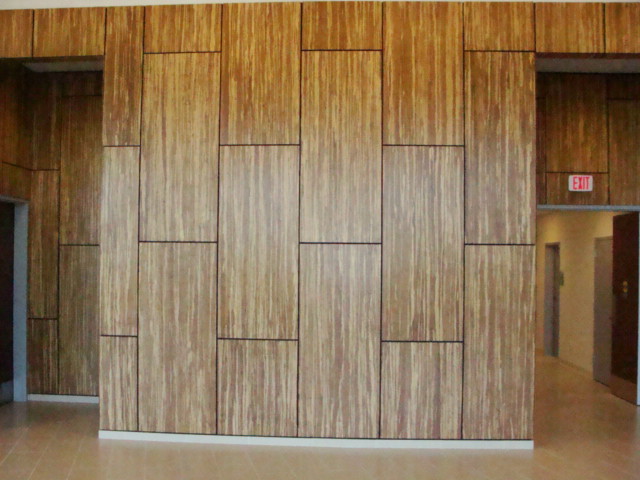
Lamboo, Inc. is pleased to announce the implementation of its products at the new KONE center in Moline, IL. Designers chose to showcase natural materials, specifically the Lamboo® Design™ Series product, Tiger Strand panel. Contemporary design was accomplished with a natural look through the sleek and modern texture of a staggered installation. This particular Tiger Strand wall panel is the adaptation of an aesthetic pattern that accomplishes an innovative look to match the building’s other sustainable design features. “The Lamboo paneling in the lobby provides an aesthetic that you cannot find anywhere in the Quad Cities and this application reinforces the sustainable and cutting-edge image the remainder of the building showcases.” Said Bryce T. Henderson, KONE’s Chief Financial and Operating Officer.


Completed in late summer 2012, the new, mixed-use building will be a significant focal point of architecture in the Quad Cities. The KONE Centre is an eight-story, 121,000-square-feet commercial office and residential condominium building located within Moline’s Bass Street Landing. The functionally designed floor plates are approximately 15,000 square feet at each level. In his new role as Project Manager, Eric Abrams was responsible for estimating, and the coordination of the construction of the new KONE Center in Moline, IL. Commenting on the application of Lamboo Tiger Strand wall panels, Eric stated that “The Lamboo Tiger Strand panel was an excellent choice selected by the Design Architect on the project. The material was within our budget and aesthetically surpassed the expectations of the design team and property owner, it was a homerun product during our value engineering process. The team at Lamboo had excellent product knowledge and was able to assist the design team in selecting the perfect material for our wall panel application. The occupants of KONE Centre are welcomed by nearly 4,500 square-feet of the renewable material, and as the project manager, I could not be more pleased with Lamboo products.”


  For questions regarding Lamboo, Tiger Strand, or to schedule an interview please
visit our website at www.lamboo.us or contact us at info@lamboo.us 866-966-2999

“MAKING INNOVATIVE THINKING A STANDARD” – Lamboo Incorporated

Blog by: Dustin Dennison

Wednesday, October 3, 2012

Success at ASLA 2012 in Phoenix!

The 2012 ASLA annual meeting & expo has came to a close, but the progress made there will last for years to come. At the show more than 375 companies showcased the latest innovative landscape products and projects many of which based on sustainable practices and renewable materials. Lamboo, Inc. was among the companies represented at the show in the Phoenix Convention Center which introduced us to many like minded architects and organizations in the field.


In addition to meeting architects and manufacturers there was great interest in integrating the ultra renewable resource of bamboo in various municipalities throughout the U.S. including New York City parks. It was apparent at the show that many designers and planners are searching for a sustainable alternative to traditional materials that can also perform exceptionally well in the elements but haven't had much success until now. Many of these individuals had heard of bamboo's potential but were unaware of it's availability for their applications previously.


Showcased at the booth were structural beams fabricated by G.R. Plume, curtain wall members from Dover, handrails from Gerber, as well as a trash receptacle and bench from Landmark Studio & Design. Lamboo would just like the thank these partners again for their great work and commitment to sustainability.


For additional information about the 2012 ASLA show or Lamboo materials please contact us at 866-966-2999 or info@lamboo.us


“MAKING INNOVATIVE THINKING A STANDARD” – Lamboo Incorporated

Blog by: Dustin Dennison

Tuesday, September 11, 2012

Powering Sustainability with the World’s First Bamboo Tender Introducing the LAMBOO Tender R1

A few weeks ago Lamboo announced the design of the world’s first tender incorporating the rapidly renewable resource of bamboo, the Lamboo® Tender R1. With the Monaco Yacht Show 2012 less than two weeks away Lamboo is providing additional details on the design for individuals involved in the maritime industry and those who will be attending the show and would like to discuss the project further.

The Lamboo® Tender R1 is a revolutionary design from Sigmund Yacht Design, a leading yacht and tender design firm which has chosen Lamboo materials not only for the sustainable attributes of bamboo but for its superior performance over traditional forms of hardwood. Also included in the design is a Steyr hybrid turbo diesel engine as well as state of the art navigation, electrical, and LED lighting systems.


“This showcase is a key example of both companies’ commitment to integration of environmentally responsible methods matched with innovative engineering of performance materials into the nautical market”
said Luke Schuette, Lamboo Founder/CEO.

The construction of the R1 is being carried out by Cockwells, a pioneer within yacht and tender fabrication specializing in advanced engineering and modern construction techniques.

Executives from all three companies will be in attendance at the 2012 Monaco show and will be available for discussion on the R1 and the integration of sustainable bamboo materials within the maritime industry.

(Read full release on PRWeb)


For questions regarding Lamboo, our products, or to schedule an interview please
visit our website at www.lamboo.us or contact us at info@lamboo.us 866-966-2999

“MAKING INNOVATIVE THINKING A STANDARD” – Lamboo Incorporated

Blog by: Dustin Dennison

Tuesday, September 4, 2012

In Africa’s Vanishing Forests, the Benefits of Bamboo

In the district of Asosa, the land is thick with bamboo. People plant it and manage the forests. They rely on its soil-grabbing roots to stabilize steep slopes and riverbanks, cutting erosion. They harvest it to burn for fuel, to make into charcoal sticks to sell to city dwellers and to build furniture.

Asosa is not in China, not even in Asia. It is a district in the west of Ethiopia, on the Sudanese border. To many people, bamboo means China. But it’s not just panda food — mountain gorillas in Rwanda also live on bamboo. About 4 percent of Africa’s forest cover is bamboo.

Soon it may be much more. Bamboo may provide a solution to a very serious problem: deforestation. In sub-Saharan Africa, 70 percent of the people cook their meals over wood fires. The very poorest cut down trees for cooking fuel; those slightly less poor buy charcoal made from wood in those same forests. Every year Africa loses forest cover equal to the size of Switzerland. Terence Sunderland, a senior scientist at the Indonesia-based Center for International Forestry Research, said that in southern Africa, even trees that can be used for fine carving, such as ebony and rosewood, are being cut down and made into charcoal.

Deforestation starts a vicious circle of drought and environmental decline. Burning wood releases the carbon stored inside. And deforestation accounts for at least a fifth of all carbon emissions globally. As tree cover vanishes, the land dries out and the soil erodes and becomes barren — a major reason for Ethiopia’s periodic famines.

Hundimo Dedere owns and manages a plantation of African highland bamboo in Southern
Ethiopia that was used as a model for modern bamboo cultivation and management training.
 
 How does bamboo improve on hardwood? Cut down a hardwood tree and it’s gone. It will take several decades for another to grow in its place; it can take a century for a forest to grow back after cutting. But bamboo is a grass, not a tree. Under the right conditions, it can grow a full meter a day — you can literally watch it grow. It is also fast maturing. A new bamboo plant is mature enough to harvest after three to six years, depending on the species. Most important, bamboo is renewable. Unlike hardwood trees, bamboo regrows after harvesting, just as grass regrows after cutting. After it is mature, bamboo can be harvested every single year for the life of the plant.

Bamboo has other advantages. Its roots grab onto soil and hold it fast. Plant bamboo on a steep slope or riverbank and it prevents mudslides and erosion. And bamboo is parsimonious with Africa’s most precious resource: water.

“In Africa you want everything,” said Dr. Chin Ong, a retired professor of environmental science at the University of Nottingham in England, who was formerly a senior scientist at the World Agroforestry Center in Nairobi. “You want firewood, you want to reduce erosion, to maintain the water supply, generate cash and employment. Bamboo comes the closest — it gives you the most things.”

In the last five years or so, Ong said, Ethiopia has realized that bamboo is a more profitable and greener solution. INBAR’s program is a four-year project financed by the European Commission and the Common Fund for Commodities, a United Nations organization. The technology comes from China. The project provides bamboo seedlings and trains people to manage bamboo plantations.

Because bamboo requires few nutrients, it can grow in soil inhospitable to other plants — not only does it thrive there, it can reclaim the land so other plants can thrive, too. Its roots leach heavy metals from the soil, hold the soil together and draw water closer to the surface. One example is a project in Allahabad, India, to reclaim land whose topsoil had been depleted by the brick industry. In 1996, an INBAR project planted the land with bamboo. Five years later, villagers could farm the land again. Dust storms — a local scourge — were greatly reduced. The bamboo also helped raise the water table by seven meters. In 2007, the project won the global Alcan Prize for Sustainability.

Bamboo's tensile strength makes it a good construction material, and it is also used for furniture, flooring and textiles, among other things.

In some ways, the challenge in Africa is not to introduce bamboo, but to persuade people and governments that it has commercial uses. “We’ve taken policymakers from Africa to China and India where bamboo used in everyday life — and there’s still very poor adoption,” said Ong.

(Read More)

(Excerpt of article by Tina Rosenberg of the New York Times. NOT AFFILIATED WITH LAMBOO) 
 
  
Lamboo strives to protect and promote this remarkable resource by working with various international organizations to ensure that the bamboo used in our products is sourced from responsibly managed bamboo plantations and nurseries. Additionally all bamboo used for Lamboo products come from a select list of bamboo species that is not used as a food source by wildlife. If you want to learn more about Lamboo’s commitment to sustainability, please contact us here.

For questions regarding Lamboo, our products, or to schedule an interview please
visit our website at www.lamboo.us or contact us at info@lamboo.us 866-966-2999

“MAKING INNOVATIVE THINKING A STANDARD” – Lamboo Incorporated

Blog by: Dustin Dennison


Monday, August 27, 2012

Sustainable Building Certifications: LEED

Sustainable building certifications have been gaining momentum for several years now and data centers are jumping on board in increasing numbers. You have seen data center operators such as RagingWire, Apple and Digital Realty achieve the U.S. Green Building Council’s LEED Certifications and/or the EPA’s Energy Star for Data Centers. Many data center operators aren’t sure which certification to pursue, or if they should pursue one at all. In order to make this decision a little easier, I have provided a synopsis of each certification and their pros and cons to help guide you toward your sustainable goals.


What is LEED?

LEED stands for Leadership in Energy and Environmental Design and is a third-party certification program developed by the U.S. Green Building Council (USGBC) in 2000. It has undergone many iterations and is now operating under LEED 2009. The certification process provides independent validation of a project’s green features and verifies that the building operates the way it was designed.

LEED Certification Process

LEED uses a points based system to achieve certain certification levels recognizing the effort and commitment by the owner and project team. There are four LEED certification levels with point requirements ranging from Base (40-49 points) to Platinum (80+ points).

At last count, there were 13 data centers that had received LEED Platinum certification.
LEED points are weighted by impact on energy efficiency and CO2 reduction. As an owner/end-user, your first decision is which LEED rating system you intend to pursue your certification under. Data centers will fall under one of the following rating systems:
  • New Construction and Major Renovations: Includes new buildings and projects in which the majority of the building will be modified.
  • Existing Buildings-Operations and Maintenance: Addresses whole building cleaning and maintenance issues. This is generally applied to a building that is in operation, but wishes to make their operational processes more sustainable.
  • Commercial Interiors: Intended for tenant improvements within an existing structure. At least 60% of the gross building area must be modified to the intended use to qualify for this rating system.
  • Core and Shell: This system is complementary to Commercial Interiors and deals with the structure, envelope and HVAC system of the building.
Other rating systems that are not applicable to the data center industry are Schools, Retail, Healthcare, Homes, and Neighborhood Development. For the purposes of data center certification, Commercial Interiors is most frequently used.

Once your rating system is chosen, points are earned through implementing green measures in each of several categories. Each category has prerequisites that must be achieved before any points are earned. The categories are:
  • Sustainable Sites: Focuses on areas related to the overall building site such as storm water run-off, pervious pavement, and availability of public transportation.
  • Water Efficiency: Measures are established related to water conservation.
  • Energy and Atmosphere: Energy efficiency measures account for most of the points in this area, which also has the largest number of points available of any category.
  • Materials and Resources: Points are awarded in this category for using rapidly renewable materials and for sourcing materials that are manufactured within 500 miles of the site.
  • Indoor Environmental Quality: This category focuses on human comfort factors such as the ability to adjust temperature and supply fresh air.
  • Innovation in Design: This is the area in which innovation is recognized for new sustainable applications.
As you see, it is critical that the decision to pursue LEED Certification is made at the beginning of the design phase to eliminate redesign associated with tailoring materials and methods to LEED standards. During design, the project is registered with the USGBC ($450 for USGBC members and $600 for non-members) indicating your intent to pursue certification.
Also during the design phase, a worksheet indicating the credits you intend to pursue is completed. As the design progresses, credits are approved toward certification. This process continues during the construction phase as the sustainable measures are implemented and documented.

Clearly, documentation is the key to gaining credit for all of your efforts and requires constant attention. This effort should not be taken lightly and must be overseen by a LEED Accredited Professional, preferably with a specialty in the rating system you are pursuing. Documentation may take 50% or more of a team members’ time during the duration of the project.
When construction is complete, the project must be commissioned to ensure that the building operates as it was designed. Given that all data centers perform this task, no additional effort is required. Upon completion of the commissioning, all documentation is submitted for final approval and a fee is paid for certification.

The USGBC states that the average cost of certification across all rating systems is $2,000, but can be as high as $27,500 for a large project. After the submission is approved, your building can be included in the LEED registry and you receive the plaque for your building.
(Read More)

(Excerpt of article by Data Center Knowledge. NOT AFFILIATED WITH LAMBOO)

For questions regarding Lamboo, our products, or to schedule an interview please
visit our website at www.lamboo.us or contact us at info@lamboo.us 866-966-2999

“MAKING INNOVATIVE THINKING A STANDARD” – Lamboo Incorporated

Blog by: Dustin Dennison


Thursday, August 23, 2012

‘Abnormally Green’ Means Truly Sustainable Materials

Baltix Sustainable Furniture and Lamboo®, Inc. partner to deliver high performance bamboo for tabletop and countertop applications!


August 22, 2012 – Lamboo, Inc. and Baltix Sustainable Furniture announced their partnership to provide the greenest commercial furniture in the industry. Through this partnership, Lamboo, Inc. will supply Baltix with a specifically engineered laminated bamboo product line for tabletops and counter tops. This specific product will be integrated into Baltix’s Green Tables Collection, which is ideal for designers that want to integrate both quality and sustainability within their products without sacrificing aesthetic value. By carefully choosing green materials, Baltix believes in embracing concepts such as weight reduction and sustainable processes aiming to provide products that allow their customers to go green with confidence.

All Baltix products are carefully manufactured utilizing computer driven technology for precision, combined with a touch of human hand for fit and finish. “Baltix recently conducted a search across the country to identify a new partner for our bamboo program. The team at Lamboo, Inc. filled the bill for us with their innovative, structural bamboo panels. It has always been our quest to partner with service oriented and like-minded, innovative and truly green manufacturers” said Baltix’s President, Chuck Lodge. This approach assures the products are of high quality whether it’s one item or one hundred. Their manufacturers are also highly efficient and use minimal waste practices, backed by a 10 year warranty, on time performance & a high level of customer service.

Lamboo offers the LAMBOO® SURFACE™ product line, engineered laminated bamboo product line designed for tabletops and counter top components. As a part of the Lamboo® Design™ series, these premium products are ideal for designers that want to integrate both quality and sustainability within their designs and integration without sacrificing aesthetic value. Lamboo Surface products now offer the perfect solution to visionary architects and designers wanting to replace traditional hardwoods, petroleum based, and synthetic materials with innovative and naturally sustainable solutions.

This partnership is formed to bring innovative solutions to use only the highest-quality raw materials, manufactured on state-of-the-art machinery and shop technology, while maintaining reputation of reliability and quality. Through partnership with Baltix Sustainable Furniture, Lamboo seeks to combine high performance bamboo products with the most innovative designs and products available in the market today.


For questions regarding Lamboo, our products, or to schedule an interview please
visit our website at www.lamboo.us or contact us at info@lamboo.us 866-966-2999

“MAKING INNOVATIVE THINKING A STANDARD” – Lamboo Incorporated

Blog by: Dustin Dennison

Wednesday, August 22, 2012

‘Green buildings’: From LEED to ‘net-zero’

“Green buildings” are structures that comply with sustainable practices throughout their life cycle – from construction, operation, maintenance, renovation and demolition. Though perhaps born in the energy crisis of the 1970’s, the green construction idea has found new urgency recently in relation to climate issues. Gaining more popularity, it is a now a key element in social measures that aim to lessen carbon footprints.

Green buildings use less water, generate energy savings, conserve natural resources, produce less waste and offer healthier spaces for its tenants, far from a conventional building’s features. Generally, they are designed to ease the sore impacts of the infrastructure both on human health and the environment.

More and more stakeholders are getting attracted to the concepts and practices of green buildings, and this has led to the creation of standards, codes and rating schemes by several organizations across different countries. These aid government regulators, developers and consumers in constructing green buildings with assurance.

Green building rating tools such as the United States’ Leadership in Energy and Environmental Design; the United Kingdom’s Building Research Establishment Environmental Assessment Method; Japan’s Comprehensive Assessment System for Built Environment Efficiency; and Malaysia’s Green Building Index, among others, help users find out how green a building is.

They recognize and credit buildings that observe green design in categories like location and site maintenance, water conservation, energy efficiency, building materials sustainability and even occupants’ comfort and health. The number of credits given generally indicates to what level a building achieves its set goals.

The LEED standard of the United States Green Building Council is touted as the most prominent of the green building rating schemes and even as having spearheaded the “modern green building movement,” according to the International Association of Plumbing and Mechanical Officials, a green industry advocate.

The race to green the buildings

In the race to develop “greener” buildings, countries are taking their concrete steps to be successful.

In the United States, President Barrack Obama took the move to the national level by issuing a memorandum in 2011 that urged all commercial buildings to be at least 20 percent more energy efficient by 2020. The president pledged to invest $4 billion to pave the way for energy upgrades in both federal and private buildings through the Better Buildings Challenge.

Among those that took the challenge was the iconic 81-year-old Empire State. Its ongoing retrofit is said to be the largest of its kind to date in the country, expected to significantly cut emissions by 105,000 metric tons over the next 15 years and reduce energy use by over $4.4 million every year. Overhaul plans for the 102 storey-skyscraper include upgrades of its 6,500 windows, new heating and cooling systems that automatically adapt to the temperature, insulation of the building space, improvement of its existing control system and installation of Internet-based system for occupants’ energy monitoring.

In Asia, countries are also working hard to keep up. China, which rivals the United States in the amount of emissions it sends to the atmosphere, is overhauling the architecture of its buildings. The 128-storey Shanghai Tower, when completed in 2014, will not only stand to be the tallest building but significantly will benchmark the green revolution in the country. It features wind turbines, a complex rainwater collection system, two envelope layers that wrap nine interior sky gardens and an ingenious design that will ease lateral loads from wind and reduces the necessary structural steel by over 20 percent.

India, on the other hand, has been vocal about its intentions to become one of the global leaders in green buildings by 2015. It has been making intensive efforts in greening the buildings across the country – ranging from home projects, factory buildings and LEED-certified buildings in India. To date, the Indian Green Building Scorecard shows that there are about 267 certified sustainable buildings existing, including some hotels, shopping centers, office spaces and state infrastructure such as the Indira Gandhi International Airport Terminal 3.

Net-Zero Buildings: The next big thing in green construction


No doubt, green buildings are booming, as venture capitalists generously invested over $4 billion on them since 2000, another report by Lux Research showed.

The study also found out that the first wave of green building start-ups has reached its maturity, and now these investors want something new and better technologies that will further improve green buildings.

“Early VC investors are looking for exits for the first wave of successful green buildings start-ups and the seeds of the next crop are being sown in on-site generation and sustainable materials,” said Ryan Castilloux, Lux Research analyst.

(Read More)

(Excerpt of article by EcoSeed. NOT AFFILIATED WITH LAMBOO)


In this new era of green construction the industry will have to search and develop innovative practices and materials to replace traditional forms that are no longer sustainable. Bamboo is a example of one of these new ultra renewable resources that will be looked towards to meet the burden of demand in our expanding society.

Bamboo as a resource is unmatched in its potential as a environmentally friendly structurally stable renewable building material. Bamboo produces 30% more oxygen and sequesters 35% more carbon than a like sized timber forest area. With a growth rate of 6-8 years to maturity (compared to timber 25-50) and root structure that eliminates the need for replanting bamboo can be produced on a large scale with much more ease than timber forests cutting costs and limiting energy consumption. Learn more about the amazing attributes of bamboo here.

Additionally incorporating Lamboo (LVB) laminated veneer bamboo into projects can earn LEED (Leadership in Energy and Environmental Design) certification under MR Credit 6 - Rapidly renewable materials, IEQ Credit 4.4 - Low-emitting materials; ID Credit 1 - Innovation in Design (Environmentally Preferable Material), and ID Credit 2 - Innovation in Design (Life Cycle Assessment / Environmental Impact).

*Please refer to USGBC for information regarding project requirements


  For questions regarding Lamboo, our products, or to schedule an interview please
visit our website at www.lamboo.us or contact us at info@lamboo.us 866-966-2999

"MAKING INNOVATIVE THINKING A STANDARD" - Lamboo Incorporated


Blog by: Dustin Dennison

Monday, August 20, 2012

Eco-friendly substitute to wood, steel and iron

While there is a thriving cement, iron, steel and wood industry, there is no such industry or even a business model to commercialize and popularize bamboo and take it to the masses, writes M. Sai Gopal

After China, India is the second largest producer of bamboo in the world. Despite this, bamboo has never been in the running to become the most sought after material for furniture, interiors and structures. It has always been the less ‘eco-friendlier’ options with wood, iron, steel and cement dominating the market.

People looking for furniture or wanting to do up the interiors have preconceived notions and tilt towards wood as the first choice. There are myriad things one can do with a piece of bamboo, yet availability of information about its versatility is limited.

However, since past few years, bamboo has emerged as a strong alternative to traditional raw materials with a promise of being eco-friendly and a tag of being a more sustainable building material. Till recently, bamboo was synonymous with ladders and scaffolding. However, in the last few years, consumers and manufacturers have started taking a ‘fresh’ look at the various other uses of this plant.

“Some bamboo species can be harvested in one to five years while it takes anywhere from 10 to 50 years for softwood and hardwood. Harvests are possible every second year for up to 120 years. The bamboo yield is 25 times higher than timber hardwoods like oak tree, which takes at least 40 years to mature before harvesting,” explains Prashant Lingam of Bamboo House India.

Technically, bamboo is a grass. And yet, it is popularly known as ‘vegetable steel’ with a tensile strength of 28,000 per square inch. The tensile strength of steel is 23,000 per square inch. When bamboo is cut, new shoots come up and they mature in just five years. While other hardwood species take at least 50 years to grow back.

“There is a definite change in perception among general public towards bamboo in the last few years. They are more positive about it and are gradually realizing that bamboo is an eco-friendly substitute to wood, steel, iron and plastic,” says Aruna lingam, who along with Prashant Lingam have pioneered the many applications of bamboo in daily lives.

So what are the applications of bamboo in our daily lives? According to Mr. Prashant, bamboo can replace wood in nearly every application. “Paper, flooring, furniture, charcoal, building materials and much more can be made from bamboo. What's more, bamboo fibres are far stronger than wood fibres and much less likely to warp from changing atmospheric conditions,” says Mr. Prashant.

(Read More)

(Excerpt of article by M. Sai Gopal of The Hindu. NOT AFFILIATED WITH LAMBOO)

Lamboo, Inc. is working towards developing the infrastructure to fully utilize this remarkable resource. Traditional building materials can be replaced in nearly any application using Lamboo (LVB) laminated veneer bamboo offering a truly sustainable replacement for both the commercial and industrial markets. From structural systems (recognized by ASTM), window & door, to complete interior remodeling Lamboo is not only a renewable resource but exhibits superior performance and durability over traditional forms of soft and hardwoods.


For questions regarding Lamboo, our products, or to schedule an interview please
visit our website at www.lamboo.us or contact us at info@lamboo.us 866-966-2999

"MAKING INNOVATIVE THINKING A STANDARD" - Lamboo Incorporated


Blog by: Dustin Dennison

Wednesday, August 15, 2012

Green Buildings: Boost Business and Neighborhoods

Seems the green building movement isn't just good for the planet, but for the pocketbook as well.


Developers and commercial building owners are increasingly using sustainable, environmentally friendly and energy efficient practices to lower costs, and the practice is spreading to include entire communities.

The U.S. Green Building Council just announced that the total footprint of commercial projects certified under its LEED (Leadership in Energy and Environmental Design) green building program surpassed 2 billion square feet. An additional 7 billion square feet is currently in the pipeline across the globe, the council reports.

Roof gardens, systems that recycle a building's heat and water, solar panels and drought-resistant landscaping have all been popular upgrades to older properties and built into new ones.

The trend has boosted business for a myriad of professions and industries. Architects and engineers who have embraced the green building movement are busy designing cutting-edge systems that save water, energy and money. Companies that manufacture or install solar collectors and other forms of sustainable energy have also benefitted from the tilt towards green.

The U.S. Green Building Council predicted that green building will support or create nearly 8 million jobs between 2009-2013 and contribute $554 billion to the U.S. gross domestic product.

Another by-product of the greening effort has been its attraction for tenants. Now there is a higher demand for healthier working space, and a recruiting edge for companies headquartered in green buildings. Improved indoor environmental quality in LEED-certified buildings has contributed to reductions in absenteeism and work hours affected by asthma, respiratory allergies, depression, and stress and to self-reported improvements in productivity, according to a study in the American Journal for Public Health.

The green development movement has expanded beyond individual buildings and has spread to include whole communities, with the U.S. Green Building Council's newest designation, LEED for Neighborhood Development.

The program, funded by a $500,000 grant from the Bank of America Charitable Foundation, aims to reduce suburban sprawl, promote smart growth principles and sustainability, and offers assistance to developers of affordable housing that employ green practices.

(Excerpt of article by Dave Winzelberg of Long Island Business News. NOT AFFILIATED WITH LAMBOO)


Recent trends show that government officials, city planners, architects and even consumers are becoming much more conscious of the environment and how rapid population growth combined with increased consumption is starting to take its toll. As finite building materials such as aluminum, steel and even slow growing timber resources become much more difficult to source and use on a large scale there will be opportunities for rapidly renewable materials to take their place. Bamboo with its extraordinary strength and performance attributes and its 6-8 year growth rate will be looked towards to carry much of the burden.

Lamboo Technologies through species selection, adhesive bonding, and lamination processes have been able to create the first structural grade bamboo material available to the world that is eligible for up to 4 LEED credits. In addition to LEED certification Lamboo has also orchestrated the inclusion of laminated veneer bamboo (LVB) into the 2012 Annual Book of ASTM Standards, one of the most recognizable and respected certification bodies in the world.

...

For questions regarding Lamboo, our products, or to schedule an interview please
visit our website at www.lamboo.us or contact us at info@lamboo.us 866-966-2999

"MAKING INNOVATIVE THINKING A STANDARD" - Lamboo Incorporated


Blog by: Dustin Dennison

Wednesday, August 8, 2012

ASTM 11a 5456 – Inclusion of Laminated Veneer Bamboo (LVB) as a Structural Composite Lumber Product


Founded in 1898, ASTM International has grown into a globally recognized leader in the development and delivery of international voluntary consensus standards. Today, over 12,500 ASTM standards are used around the world to improve product quality, enhance safety, facilitate market access and trade, and build consumer confidence.

The 2012 Annual Book of ASTM Standards has one historic addition under “Evaluation of Structural Composite Lumber Products” as it lists laminated veneer bamboo (LVB) as a certified product for structural applications under ASTM 11a 5456. The D07 orchestration of the inclusion of LVB in ASTM Standards has been a goal Lamboo Incorporated President Luke Schuette and Bruce Craig, Director of Certifications have been working towards since 2007.

Craig, with over 32 years of experience in the field of engineered wood product research and development specializes in product certifications, product development, and quality assurance for engineered wood products. Through his efforts and that of Schuette this inclusion marks the first bio-based structural material addition in around 30 years.

“Sustainability is becoming more and more of a focus in commercial construction. Now architects and engineers will be able to specify possibly the most ecologically friendly material to ever be integrated into the most respected international standard.” Said Luke Schuette, Architect, and Chairman of ASTM task group D07.02.03.


D5456 is a standard specification for evaluation of structural composite lumber products that is intended for use as an engineering material for a variety of end-use application. (ASTM standards, D5456) Schuette, chairman of the task group ASTM D07.02.03 along with Craig, a 22 year ASTM member, have drafted and revised standards to be set forth, for the future use of Bamboo as a structural application. This specification recognizes the complexity of structural glued products.

This certification is a major step forward in the transition from finite building materials such as aluminum to rapidly renewable resources in the construction and architectural industries. Bamboo has always been touted for its remarkable attributes to grow and replenish much more rapidly than traditional forms of timber (6-8 years) but this certification also showcases bamboo’s superior strength and performance. The necessity for transition from less renewable sources such as steel, aluminum, and even timber is a reality that the industry must come to terms with.


For questions regarding Lamboo, our products, or to schedule an interview please
visit our website at www.lamboo.us or contact us at info@lamboo.us 866-966-2999

"MAKING INNOVATIVE THINKING A STANDARD" - Lamboo Incorporated


Blog by: Dustin Dennison