Showing posts with label panels. Show all posts

Tuesday, November 11, 2014

New Site for Interior Design Millwork Products and Solutions


Lamboo, Inc. invites everyone to visit our new interior design and millwork site for your product integration needs. This new site was designed to allow our valued clients and customers to more easily access our interior millwork solutions through the integration of panels, veneer, and components. This ultra-simplified and streamlined site also allows for ease of specification and understanding of the products, applications, and solutions. This site will appeal to architects, engineers, and design professionals whom appreciate the performance, sustainability, and aesthetics and the multifaceted characteristics that our Lamboo® Design™ series of products have to offer.  Please direct any inquiries for Lamboo® Design™ via our new product website here! For more information about Lamboo® material technologies, please email us at info@lamboo.us.


Thursday, November 1, 2012

Implementation of Bamboo Wall Panels at the New KONE Center


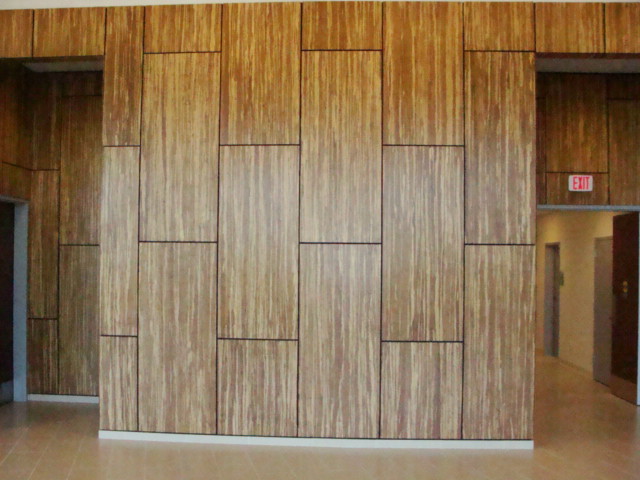
Lamboo, Inc. is pleased to announce the implementation of its products at the new KONE center in Moline, IL. Designers chose to showcase natural materials, specifically the Lamboo® Design™ Series product, Tiger Strand panel. Contemporary design was accomplished with a natural look through the sleek and modern texture of a staggered installation. This particular Tiger Strand wall panel is the adaptation of an aesthetic pattern that accomplishes an innovative look to match the building’s other sustainable design features. “The Lamboo paneling in the lobby provides an aesthetic that you cannot find anywhere in the Quad Cities and this application reinforces the sustainable and cutting-edge image the remainder of the building showcases.” Said Bryce T. Henderson, KONE’s Chief Financial and Operating Officer.


Completed in late summer 2012, the new, mixed-use building will be a significant focal point of architecture in the Quad Cities. The KONE Centre is an eight-story, 121,000-square-feet commercial office and residential condominium building located within Moline’s Bass Street Landing. The functionally designed floor plates are approximately 15,000 square feet at each level. In his new role as Project Manager, Eric Abrams was responsible for estimating, and the coordination of the construction of the new KONE Center in Moline, IL. Commenting on the application of Lamboo Tiger Strand wall panels, Eric stated that “The Lamboo Tiger Strand panel was an excellent choice selected by the Design Architect on the project. The material was within our budget and aesthetically surpassed the expectations of the design team and property owner, it was a homerun product during our value engineering process. The team at Lamboo had excellent product knowledge and was able to assist the design team in selecting the perfect material for our wall panel application. The occupants of KONE Centre are welcomed by nearly 4,500 square-feet of the renewable material, and as the project manager, I could not be more pleased with Lamboo products.”


  For questions regarding Lamboo, Tiger Strand, or to schedule an interview please
visit our website at www.lamboo.us or contact us at info@lamboo.us 866-966-2999

“MAKING INNOVATIVE THINKING A STANDARD” – Lamboo Incorporated

Blog by: Dustin Dennison

Monday, September 17, 2012

Bamboo goes commercial

Jamaica is now set to enter bamboo production on a commercial basis, having gained entry as the 38th member to the International Network for Bamboo and Rattan (INBAR).
Jamaica already produces furniture and household items from bamboo, much of which is done by informal craft traders, but the new program is meant to devise more hardy and quality products.

The plant grows prolifically throughout Jamaica.

Gladstone Rose, chairman of the Bamboo industry Advisory Committee at the Bureau of Standards Jamaica (BSJ), said Thursday that INBAR membership gives Jamaica access to technology transfer models and other documents that the agency can use to guide private companies to develop bamboo prototypes.

The prototypes include bamboo plywood, bamboo tiles, bamboo board, bamboo students chairs and other engineered bamboo products using the most prolific local variety of bamboo, Bambusa vulgaris.

"The team has successfully produced bamboo products prototypes but now seek venture capital to supply already identified markets locally and in the United States of America," Rose told Sunday Business.

The BSJ work is focused initially on Glengoffe, where training sessions using the INBAR material has been under way since April. The workshops will span two years.

INBAR is an intergovernmental organization headquartered in China, comprising countries that have bamboo or rattan resources in quantities that can be commercialized.

Through its network of member countries, organizations and individuals from all continents of the world, INBAR develops and assists in the transfer of appropriate technologies and solutions to benefit the peoples of the world and their environment," said Rose.

"Information on 122 Chinese bamboo and rattan products/process standards have been received which will help the BSJ and bamboo products producers rapidly develop Jamaican standards and ultimately create a modern standards-led bamboo products industry," he said.

The BSJ earlier this year was designated by the Ministry of Industry Investment and Commerce to be the focal point for INBAR in Jamaica.

"The Government of Jamaica recognizes that bamboo is a valuable renewable resource which grows rapidly and therefore is a good substitute source for wood instead of timber, obtained by cutting down trees which takes on average 40 years to grow to maturity," Rose said.

The Bamboo Industry Advisory Committee, which he heads, was set up by the BSJ to oversee the development of pilot projects, studies and product prototypes.

The committee also plans to publish its own guidance documents for use of the new bamboo industry that Jamaica expects to emerge from the INBAR project.

"Such documents will prescribe standards, policies and ethical practices for the industry," Rose said.

The standards-led industry is to be developed over a two-year period. The project incorporates entities such as the state-run Forestry Department and the Jamaica Wood Products and Furniture Association representing private operators.

Rose said bamboo manufactured products will include school furniture, including desks and chairs, while bamboo plywood will be used to make doors, skirting and moldings.

Bamboo was first introduced in Jamaica to strengthen riverbanks. A Forestry Department count in 2000 found that the plant covered more than 44,000 hectares nationwide. Today, Rose says there are 47,000 hectares of bamboo growing wild.

Around 1999-2000, according to the Lewis-Nelson paper, the Forestry Department, backed by private sponsorship, imported and erected a "bamboo-concrete house" using material and technical resources from Costa Rica.

"It generated much interest from a wide variety of persons, groups and institutions, but has not realized the desired effect of utilizing local bamboo for low-cost housing on a large scale," the paper said.

Market leader China has developed its bamboo industry into a US $14-billion enterprise, of which US $2-billion worth of products is exported to the West, according to Rose.

"The value of Jamaican manufacture is minuscule by comparison," said the BSJ executive. "We are trying to create a new industry."

(Read More)

(Excerpt of article by Avia Collinder, of The Gleaner. NOT AFFILIATED WITH LAMBOO) 

Lamboo is a manufacturer of laminated veneer bamboo (LVB) for structural and interior design applications. Lamboo can be utilized in a variety of products and systems from window & door units, curtain wall systems, industrial shipping containers to table tops and yacht interiors. Lamboo materials can be used as a substitute to traditional wood in nearly every application as a rapidly renewable and sustainable alternative. The strength of bamboo has lead to it being referred to as ‘vegetable steel’ with a tensile strength of 28,000 per square inch.

Bamboo has long been revered for its enormous potential as a building product but is only now starting to be fully utilized. That is something very exciting and will play a huge role in the future.


For questions regarding Lamboo, our products, or to schedule an interview please
visit our website at www.lamboo.us or contact us at info@lamboo.us 866-966-2999

“MAKING INNOVATIVE THINKING A STANDARD” – Lamboo Incorporated

Blog by: Dustin Dennison

Tuesday, September 11, 2012

Powering Sustainability with the World’s First Bamboo Tender Introducing the LAMBOO Tender R1

A few weeks ago Lamboo announced the design of the world’s first tender incorporating the rapidly renewable resource of bamboo, the Lamboo® Tender R1. With the Monaco Yacht Show 2012 less than two weeks away Lamboo is providing additional details on the design for individuals involved in the maritime industry and those who will be attending the show and would like to discuss the project further.

The Lamboo® Tender R1 is a revolutionary design from Sigmund Yacht Design, a leading yacht and tender design firm which has chosen Lamboo materials not only for the sustainable attributes of bamboo but for its superior performance over traditional forms of hardwood. Also included in the design is a Steyr hybrid turbo diesel engine as well as state of the art navigation, electrical, and LED lighting systems.


“This showcase is a key example of both companies’ commitment to integration of environmentally responsible methods matched with innovative engineering of performance materials into the nautical market”
said Luke Schuette, Lamboo Founder/CEO.

The construction of the R1 is being carried out by Cockwells, a pioneer within yacht and tender fabrication specializing in advanced engineering and modern construction techniques.

Executives from all three companies will be in attendance at the 2012 Monaco show and will be available for discussion on the R1 and the integration of sustainable bamboo materials within the maritime industry.

(Read full release on PRWeb)


For questions regarding Lamboo, our products, or to schedule an interview please
visit our website at www.lamboo.us or contact us at info@lamboo.us 866-966-2999

“MAKING INNOVATIVE THINKING A STANDARD” – Lamboo Incorporated

Blog by: Dustin Dennison

Thursday, August 23, 2012

‘Abnormally Green’ Means Truly Sustainable Materials

Baltix Sustainable Furniture and Lamboo®, Inc. partner to deliver high performance bamboo for tabletop and countertop applications!


August 22, 2012 – Lamboo, Inc. and Baltix Sustainable Furniture announced their partnership to provide the greenest commercial furniture in the industry. Through this partnership, Lamboo, Inc. will supply Baltix with a specifically engineered laminated bamboo product line for tabletops and counter tops. This specific product will be integrated into Baltix’s Green Tables Collection, which is ideal for designers that want to integrate both quality and sustainability within their products without sacrificing aesthetic value. By carefully choosing green materials, Baltix believes in embracing concepts such as weight reduction and sustainable processes aiming to provide products that allow their customers to go green with confidence.

All Baltix products are carefully manufactured utilizing computer driven technology for precision, combined with a touch of human hand for fit and finish. “Baltix recently conducted a search across the country to identify a new partner for our bamboo program. The team at Lamboo, Inc. filled the bill for us with their innovative, structural bamboo panels. It has always been our quest to partner with service oriented and like-minded, innovative and truly green manufacturers” said Baltix’s President, Chuck Lodge. This approach assures the products are of high quality whether it’s one item or one hundred. Their manufacturers are also highly efficient and use minimal waste practices, backed by a 10 year warranty, on time performance & a high level of customer service.

Lamboo offers the LAMBOO® SURFACE™ product line, engineered laminated bamboo product line designed for tabletops and counter top components. As a part of the Lamboo® Design™ series, these premium products are ideal for designers that want to integrate both quality and sustainability within their designs and integration without sacrificing aesthetic value. Lamboo Surface products now offer the perfect solution to visionary architects and designers wanting to replace traditional hardwoods, petroleum based, and synthetic materials with innovative and naturally sustainable solutions.

This partnership is formed to bring innovative solutions to use only the highest-quality raw materials, manufactured on state-of-the-art machinery and shop technology, while maintaining reputation of reliability and quality. Through partnership with Baltix Sustainable Furniture, Lamboo seeks to combine high performance bamboo products with the most innovative designs and products available in the market today.


For questions regarding Lamboo, our products, or to schedule an interview please
visit our website at www.lamboo.us or contact us at info@lamboo.us 866-966-2999

“MAKING INNOVATIVE THINKING A STANDARD” – Lamboo Incorporated

Blog by: Dustin Dennison

Thursday, August 16, 2012

The world's first bamboo tender. Introduced by Lamboo and Sigmund Yacht Design


Lamboo would like to introduce the world’s first tender designed with the rapidly renewable resource of bamboo, the Lamboo® Tender R1.

A tender is a small vessel designed to be lightweight and agile to ferry supplies and passengers between a larger vessel such as a yacht to other ships.

Sigmund Yacht Design
, leading yacht and tender design firm, chose Lamboo materials due to the superior strength and performance attributes of our laminated bamboo.

This showcase is a key example of both companies’ commitment to integration of environmentally responsible methods matched with innovative engineering of performance materials into the nautical market.

Stay connected for future updates on the release of the first R1 model by subscribing to this blog.


For questions regarding Lamboo, our products, or to schedule an interview please
visit our website at www.lamboo.us or contact us at info@lamboo.us 866-966-2999

"MAKING INNOVATIVE THINKING A STANDARD" - Lamboo Incorporated


Blog by: Dustin Dennison

Wednesday, August 8, 2012

ASTM 11a 5456 – Inclusion of Laminated Veneer Bamboo (LVB) as a Structural Composite Lumber Product


Founded in 1898, ASTM International has grown into a globally recognized leader in the development and delivery of international voluntary consensus standards. Today, over 12,500 ASTM standards are used around the world to improve product quality, enhance safety, facilitate market access and trade, and build consumer confidence.

The 2012 Annual Book of ASTM Standards has one historic addition under “Evaluation of Structural Composite Lumber Products” as it lists laminated veneer bamboo (LVB) as a certified product for structural applications under ASTM 11a 5456. The D07 orchestration of the inclusion of LVB in ASTM Standards has been a goal Lamboo Incorporated President Luke Schuette and Bruce Craig, Director of Certifications have been working towards since 2007.

Craig, with over 32 years of experience in the field of engineered wood product research and development specializes in product certifications, product development, and quality assurance for engineered wood products. Through his efforts and that of Schuette this inclusion marks the first bio-based structural material addition in around 30 years.

“Sustainability is becoming more and more of a focus in commercial construction. Now architects and engineers will be able to specify possibly the most ecologically friendly material to ever be integrated into the most respected international standard.” Said Luke Schuette, Architect, and Chairman of ASTM task group D07.02.03.


D5456 is a standard specification for evaluation of structural composite lumber products that is intended for use as an engineering material for a variety of end-use application. (ASTM standards, D5456) Schuette, chairman of the task group ASTM D07.02.03 along with Craig, a 22 year ASTM member, have drafted and revised standards to be set forth, for the future use of Bamboo as a structural application. This specification recognizes the complexity of structural glued products.

This certification is a major step forward in the transition from finite building materials such as aluminum to rapidly renewable resources in the construction and architectural industries. Bamboo has always been touted for its remarkable attributes to grow and replenish much more rapidly than traditional forms of timber (6-8 years) but this certification also showcases bamboo’s superior strength and performance. The necessity for transition from less renewable sources such as steel, aluminum, and even timber is a reality that the industry must come to terms with.


For questions regarding Lamboo, our products, or to schedule an interview please
visit our website at www.lamboo.us or contact us at info@lamboo.us 866-966-2999

"MAKING INNOVATIVE THINKING A STANDARD" - Lamboo Incorporated


Blog by: Dustin Dennison

Tuesday, July 17, 2012

Mechanical and structural marvel gives lesson in resource conservation

Richmond Olympic Oval


At night the structure of the building is clearly visible: the main arches that span 100m across the sports hall spring from inclined concrete buttresses, while the gently curved roof panels soften the silhouette [photo by Hubert Kang].

The Richmond Olympic Oval was the largest structure to be built for the 2010 Olympic Winter Games held in Vancouver and Whistler BC. The Oval was designed to accommodate the Olympic long track speed-skating events with seating for 8,000 spectators, before being transformed into a multi-sports training and recreation facility after the Games. Located adjacent to the Middle Arm of the Fraser River minutes from Vancouver’s international airport, the facility will become the focus of a new residential and commercial neighbourhood.

With a plan area of 25,000 m2 and a total floor area of more than 47,000 m2 the complexities and scale of this building, and the need to reconcile them with the client’s requirement to achieve LEED Silver certification, meant that a truly integrated approach to design was essential from the outset. The process began with goal-setting meetings and continued at regular intervals throughout the project, at times bringing together a team of more than 25 consultants.

The building is arranged on three levels: a parking garage; a ground-oriented entry, circulation, service and amenity level; and above, the activity level including the main sports hall and a mezzanine for fitness. The vaulted sports hall with its 100m span, unique wood roof and expansive views north to the river and Coast Mountains is the architectural highlight of the project.
The concrete box formed by the lower floors acts as a rigid raft, and rests on shallow expanded-base piles that resist differential settlement in the poor soil conditions. This system is designed to maintain the tight tolerances of ice surface flatness required for international competition. The second floor slab connects opposing pairs of concrete buttresses that support the shallow arched roof and resist the large spreading loads that would otherwise be directed into the ground.


Wood Roof Structure


Composite glulam and steel arches spring from the tops of the inclined concrete buttresses to free span the width of the arena. Spanning between these arches is a novel pre-fabricated structural panel system, known as the WoodWave©. This system employs conventional light framing lumber harvested from forests devastated by the Mountain Pine Beetle.

Because it comes from a renewable resource, requires little energy to process, and has no toxic by-products, solid sawn lumber is by far the least energy intensive and least polluting of the major construction materials. With more than 450 panels covering the 2.5-hectare roof, the WoodWave© system has greatly expanded the understanding of what is achievable using conventional sawn lumber.

The V-shaped cross sectional geometry of the arches is maintained using a horizontal steel truss that creates a very stable structure and a hollow space inside, which conceals the main mechanical services. Holes drilled through the beams at intervals allow for the ventilating system to distribute warm or cold air as required, and for sprinkler lines and conduits to connect to branch lines concealed in the WoodWave© panels.


(Excerpt of article by Jim Taggart of SABMag. NOT AFFILIATED WITH LAMBOO)


This is a great example of engineered wood used within the construction industry in the hopes of building more sustainable structures for the future. Although this material is a step in the right direction timber resources are continually strained due to the long life cycle and expensive process of clearing roots and replanting. Bamboo is another resource that could be utilized due to its remarkable growth rate (6-8 years to maturity versus 25-50 for timber) and ability to regrow from previous root structures. Using this remarkable resource Lamboo Technologies is able to offer an alternative to wood that is not only more sustainable but features greater stability and performance compared to any other plant species on the planet. Lamboo materials are manufactured through a patented lamination process which can produce members and components to replace wood in any application while increasing stability and longevity. Learn more about the sustainability of Lamboo products here.
For questions regarding Lamboo, our products, or the growing importance
of bamboo in sustainable construction please visit our website at
www.lamboo.us
or contact us at info@lamboo.us - 866-966-2999

"MAKING INNOVATIVE THINKING A STANDARD" - Lamboo Incorporated


Blog by: Dustin Dennison

Tuesday, June 12, 2012

Green Building Materials

Attributes that help determine if a building material is “green” include whether the product is - natural - renewable - non-toxic - made of recycled materials - produced locally - reusable - certified sustainable. A material does not have to have all these attributes to be considered green, but, in general, the more of these attributes it does have the better.

BAMBOO

Bamboo is one of the earth’s fastest-growing plants and can be grown without the use of fertilizers or pesticides. While most trees typically need decades to grow before they can be harvested, bamboo requires only four to six years. Bamboo has also been reported to sequester 35% more carbon than trees, making it attractive in the battle to reduce atmospheric carbon dioxide levels. Because of these qualities, bamboo has become a popular material for use in a variety of green products.

Not all bamboo is the same. Luke Schuette, president of Lamboo®, Inc., notes, “there are nearly 1600 species of bamboo worldwide. Some are soft while others are very dense.” To engineer a laminated bamboo product suitable for structural use in buildings, including horse barns, Lamboo, Inc. uses five species of bamboo that are harder than wood. “The structural capacity of Lamboo,” says Schuette, “is over three times stronger on average than wood.”

In addition to considering the strength of a material used in a horse barn, it is essential that any building material used in your barn is safe for your horse. “It’s really important to be wary of what may be marketed as ‘green’ substitutes for wood products to be sure they aren’t toxic, either in the material itself or the binding agents, and how it does or does not splinter if chewed since horses will nibble on whatever’s within reach,” notes Blackburn. According to Schuette, testing performed by Lamboo concluded it is safe for animal consumption, and horses are less likely to nibble on bamboo compared to wood.

An added benefit of Lamboo is that it burns more slowly than wood due to its increased density, making it less of a fire risk.

 (Read more)

(Excerpt of article by Josh Englander of HolisticHorse.com.

For questions regarding Lamboo or our products please visit our
website at www.lamboo.us or contact us at info@lamboo.us

"MAKING INNOVATIVE THINKING A STANDARD" - Lamboo Incorporated


Blog by: Dustin Dennison

Wednesday, June 6, 2012

Lamboo: Bamboo Made Better?

The idea behind engineered wood products (EWP) is to make wood stronger and more flexible in terms of design applications like long-spans and curved beams. Bamboo is already a highly regarded, sustainable wood species, and now one company is trying to make it better by turning the best kinds of bamboo into an EWP.


Made of thin layers of bamboo held together by adhesives, Lamboo is an engineered, high-performance bamboo product for exterior and interior applications such as beams, trusses, panels, awning systems and more. Choosing from 1,600 different species of bamboo, the company has isolated four with the strongest cellular structures to compose its Lamboo product, which is reported to be ten times stronger in tension, three times stronger mechanically, and twenty percent more stable in moisture and temperature changes compared to its wood counterparts.


And then there are the inherent advantages of bamboo itself, one of the fastest growing plants in the world. It’s an easily renewable resource and a building material that offers some of the highest strength and stability ratings. Bamboo has a warm and soft texture that has won many fans in the remodeling world. So the question is, can Lamboo improve a wood species that’s already excellent in terms of performance and sustainability? I’d like to know.

You can request a quote or order samples from the Lamboo website.

(Read more)

(Excerpt of article by Josh Englander of HGTV Remodels.

For questions regarding Lamboo or our products please visit our
website at www.lamboo.us or contact us at info@lamboo.us

"MAKING INNOVATIVE THINKING A STANDARD" - Lamboo Incorporated


Blog by: Dustin Dennison

Wednesday, May 30, 2012

Are Bamboo Products The Future of Retail?

It's no surprise that the growing popularity and trendiness of “green living” has given rise to an entirely new subset in the global retail industry. With new and recent demands by the public that no longer exclusively includes the extremist eco-conscious microcosm, more sustainable products in retail aimed at the widespread general population are pushing through the niche market into the mainstream.

At the heart of this exponential increase in the green retail marketplace is the material bamboo that encompasses what sustainability represents while being chameleon enough to provide every type of eco-friendly product one could demand. On top of that, Bamboo has the capabilities to produce both quality and aesthetically pleasing products that are able to capture the interest of the mainstream public who are often set in their comfortable buying patterns that can be hazardous for the environment. This combination of sustainability, durability, versatility and beauty makes one wonder that if, while the future of capitalism is sure to be green, is the future of retail rooted in bamboo? All predictions and market trends are pointing towards the affirmative with the industry expected to be worth $25 billion in 2012. What was once overlooked as a predominantly third world material or decorative piece in tropical motifs is about to tidal wave through the global retail industry. Here's why:

Sustainability
Since it can easily adapt easily to changing temperatures, climates, and soil conditions, bamboo can grow everywhere and in almost any condition except Antarctica. It is also naturally anti-bacterial, anti-fungal and anti-pest which makes the need for pesticides null and void. Bamboo produces greater biomass and 30% more oxygen than a hardwood forest of comparable size.

Renewability
Bamboo grows on average 1.6 feet per hour and reaches maturity in about five years making it the fastest growing and most renewable plant on earth. Compare this to Oak, which grows on average 12 inches per year and can take 120 years to mature. To put this in perspective, a sixty-foot tree cut for market takes 60 years to replace and a sixty-foot bamboo cut for market takes 59 days to replace.

Durability
The tensile strength, or the ability to withstand stress, of bamboo surpasses that of steel. Bamboo’s tensile strength is 28,000 per square inch, while steel rates only 23,000 per square inch. That’s why bamboo is used as a building material in areas often wrought with earthquakes.

Versatility
Bamboo is material that can and is used for almost everything. It is popular as a building material such as flooring, furniture and structures in earthquake-ridden areas. Bamboo products are a choice for clothing, textiles and even paper. In fact, there is not a single industry that bamboo doesn’t touch as it can even substitute for charcoal.


Restorative
Bamboo not only produces more oxygen but helps to actually reduce carbon dioxide gases faster than other plants, which can help reverse the effects of global warming. Since it is highly adaptable to most climates and soil conditions it can help restore degraded and damaged lands. It also acts as a natural water control barrier, which helps reduce rain run off and soil erosion.

Aesthetically Pleasing
Simply put, bamboo is pretty. Its universally appealing aesthetic makes it popular for both those that lean towards trendy designs and those that favor a more classic look. Bamboo products have a smooth sleek texture that is pleasing to touch and symmetrical design pattern that people like to look at. It produces soft clothing, savory food, unique looking buildings and even good-looking gadgets.

Bamboo products are the new kings of the green and environmentally friendly retail market. With its flawless reputation and ability to “do it all” the trend towards bamboo becoming the future of all retail seems imminent.

(Read more)

(Excerpt of article by Greg Voakes of Business Insider.


For questions regarding Lamboo or our products please visit our
website at www.lamboo.us or contact us at info@lamboo.us

"MAKING INNOVATIVE THINKING A STANDARD" - Lamboo Incorporated
Blog by: Dustin Dennison

Wednesday, May 16, 2012

Lamboo® Elite™ Series

Lamboo, Inc. is pleased to announce that they will be showcasing the Lamboo® Elite™ Series of Products specific to the Aviation Industry within one of the most prestigious shows in the world for the elite business Jet industry, The Farnborough International Airshow July 9th-15th. Lamboo is currently collaborating and supplying premium products into the custom interior jet industry and will be available to discuss supply agreements with current and new players in the market.


Products:
Premium Engineered Bamboo Veneer – For Jet Interiors
Premium Engineered Bamboo Components – For Jet Interiors
Premium Engineered Bamboo Panels – For Jet Interiors


*All of our Elite™ products meet the most stringent of Aviation Standards and Certifications Required for the industry.

Lamboo, Inc. and their premium products will be located at booth #H2/B17 and will be represented by Peter Illig, the Managing Director of Lamboo International, based in Switzerland, and our Director of R&D Luke D. Schuette, from the Lamboo, Inc. USA office.

Please contact Debby Richardson for any questions regarding this
show or Lamboo® Elite™ for Jet Interiors. debby@lamboo.us

Friday, May 11, 2012

In Bali, Bamboo Is the Bricks and Mortar


SIBANG, INDONESIA — When Macarena Chiriboga came to Bali in 2009, she had just finished a master’s degree in architecture in the United States, doing her thesis on the use of bamboo as a building material.

The trip was meant to be a vacation. But drawn by the unusual architecture of a school on the island — the Green School, whose buildings are all made from bamboo — she was soon back, and is now designing buildings for a “green village” being built by the developer Ibuku International about an hour’s drive from the Indonesian island’s beaches.

With Effan Adhiwira, a 28-year-old Indonesian who is senior architect and also oversees construction at Green School, the Ibuku team is creating a collection of structures that look more like treehouses and pirate ships than luxury villas.

But they are actually luxury villas. Perched on huge bamboo poles, and overshadowed by lush green jungle on the edge of the rock-strewn Ayung River, they have multiple, verandah-like levels, beautifully designed kitchens and bathrooms, and very few walls.

“People tend to have this assumption that luxury is all about air-conditioning and technology, about owning a big car — but luxury can also be about feeling the wind blow right through your house, being in contact with nature and walking around barefoot in your home,” said Ms. Chiriboga, 26. “These houses are all about allowing people to realize their dream of sustainable living, of experiencing a whole different lifestyle.”

Three dozen buildings will ultimately form the “Green Village,” which is going up on three hectares, or almost 7.5 acres, of land. Giant, 18-meter, or 59-foot, poles, each about 25 centimeters, or nearly a foot, wide, support the roofs and several layers of open-plan floors. Some jut out, mast-like, at odd angles. Smaller, slimmer poles form open-sided stairs that lead from one platform-like level to the next — three or four in each house.

The flooring, the roofs, the banisters that fence in the terrace-like living spaces, but leave the sides open — everything is made of bamboo, lightweight, bendable, super-tensile and specially treated to protect it from the ravages of insects and humidity.

There’s hardly a right angle in sight. Curves and gentle bends rule. “We’re taking bamboo to a different level,” said Ms. Chiriboga, who is from Ecuador. “Where I come from, in South America, bamboo is seen as a poor man’s material. If you’re rich, you won’t use it to build a house. When I show people pictures of what we’re doing here, they are amazed. They never thought you could do these things with bamboo.”

Each of the houses is unique, fitted around the plot on which it is built, said Elora Hardy, creative director at Ibuku. There was no need to bulldoze the jungle, dig foundations and build retaining walls: The structures simply rest on poles anchored in the rock, contouring around their part of the steep river bank.

Each is to some extent tailored to the buyer’s special wishes: Want an open-plan office-cum-media room? Or two rather than three bedrooms? An extra guest bathroom? But, of course.

“It’s like building a super yacht, made to measure, in the middle of the jungle,” said Peter Wrathall, commercial director at Ibuku. At a cost of $225,000 to $750,000 each, the buildings are drawing interest from around the world, he said.

Indonesia as a whole, and Bali in particular, has become increasingly popular with foreign investors, drawn by the country’s friendly climate and buoyant economy. Foreigners cannot own land or houses directly in their own name in the country but it is possible, and common, for them to arrange ownership through local nominees or surrogates. Another option is to acquire long-term leases of as long as 25 years, which can be transferable and extendable, and are thus an attractive alternative, Mr. Wrathall said.

Possibly the most unusual aspect of the Ibuku houses — apart from the fact that they are 98 percent bamboo — is that their sides are largely open to the elements.

Beneath the canopy-like roofs, which are in turn overshadowed by the jungle, there are only floors and the bamboo support pillars. The houses have 150 to 300 square meters, or 1,615 to 3,230 square feet, of living space, but no walls, no windows.

That may sound unbearably hot and steamy, but there generally is a gentle breeze blowing through the structures.

Buyers can opt to have parts of their houses enclosed — with bamboo walls — so the areas can be cooled and dehumidified. But most areas are free of energy-guzzling air-conditioning and costly insulation materials. Ibuku also plans to take the whole “village” off Bali’s electric grid, providing power from biomass, the energy given off by decaying natural materials — all in line with the green, environmentalist philosophy that pervades the development.

(Read full article)

(Excerpt of article by Bettina Wassener of the New York Times.


For questions regarding Lamboo or our products please visit our
website at www.lamboo.us or contact us at info@lamboo.us

"MAKING INNOVATIVE THINKING A STANDARD" - Lamboo Incorporated

Friday, April 20, 2012

Lamboo, Inc. launches the latest innovation in engineered bamboo for tabletops and countertops market.


Lamboo® Technologies latest innovation in engineered bamboo now offers Lamboo® Surface™ to its Design™ Series product line. Lamboo® Surface™ is focused on integrating performance, sustainability, and aesthetics to the tabletop and counter top markets.  Lamboo® Surface™ products will be the perfect solution to visionary architects and designers wanting to replace traditional hardwoods, petroleum based, and synthetic materials with innovation and sustainable solutions.  
 
Lamboo® Surface™ material is a naturally anti-microbial product which makes this products ideal for tabletop and countertop applications. "We would like to provide an innovative solution to the common products used in the tabletop and component industries. We believe that this product line is the solution for designers and architects willing to promote sustainability and innovation.” Says V.P. of Operations, Jeran Hammann. The very nature of Lamboo® Surface™ products exemplify our values to be a force for positive change and our commitment to long term environmental, social, and economic benefits for all of our communities. 
 
The Lamboo® Surface™ collection reaches both commercial and residential applications. Some of the applications are as follows:
 
In addition to our commitment to innovation in sustainable design practices Lamboo is focused on operations that surpass ethical standards in the industry.  Lamboo, Inc. meets BBB accreditation standards, and strives to maintain good faith both with stakeholders and consumers.

For questions regarding Lamboo or our products please visit our
website at www.lamboo.us or contact us at info@lamboo.us

"MAKING INNOVATIVE THINKING A STANDARD" - Lamboo Incorporated

Blog by: Dustin Dennison