Thursday, January 10, 2013

BAU 2013


BAU the world's leading building annual trade fair will be held in Munich Germany January 14 – 19, 2013. BAU showcases the latest trends in architecture, materials and systems for industrial, commercial and residential construction and for interior design. Exhibits are divided according to building material, product and theme areas – key themes for the future such as sustainable building play an important role in all sections of the exhibition.

BAU targets all those involved in planning, designing and building: engineers, architects and project developers and also the building trades, building materials retailers, building firms and representatives of the housing industry.

Lamboo partners Raico and Solarlux will be in attendance showcasing their latest innovative designs and products. As industry leaders in the window, door, and curtain wall markets they have chosen to implement Lamboo's laminated veneer bamboo (LVB) due to its superior performance and longevity.

Exhibitor Information


RAICO GmbH | Booth: B1.308
Tel: +49 8265 9110
Email: info@raico.de
Web: www.raico.de
Products


SOLARLUX GmbH | Booth: C1.329
Tel: +49 5402 4000
Email: info@solarlux.de
Web: www.solarlux.com
Products 

For questions regarding Lamboo or our products please visit our website
at www.lamboo.us or contact us at info@lamboo.us866-966-2999

“MAKING INNOVATIVE THINKING A STANDARD” – Lamboo Incorporated


Tuesday, January 8, 2013

Evolving Building Codes: Wood Revolution

Pushing the boundaries of innovative wood design and construction

There is a quiet revolution taking place within the design community. After a prolonged emphasis on concrete and steel for buildings other than homes, design professionals are using wood to great effect in a growing number of non-residential and multi-family building types—in applications that range from traditional to innovative, even iconic. Some are driven by wood's cost effectiveness while others cite its versatility or low carbon footprint, but their collective path has been made possible by building codes that increasingly recognize wood's structural and performance capabilities, and the continued evolution of wood building systems and techniques.

When the International Building Code (IBC) was introduced in 2000, it consolidated three regional model building codes into one uniform code that has since been adopted by most jurisdictions. It increased the possibilities for wood construction by (among other things) recognizing additional fire protection techniques, consolidating the maximum allowable areas and heights from the three legacy codes into one (thus increasing what's allowable in some jurisdictions), and allowing the use of wood in a wider range of building types. In subsequent versions of the IBC, even more opportunities have been created where additional fire protection features are used.

Even so, the pioneering nature of building design is such that there are always architects and engineers seeking to push beyond the conventional, and it is common for project teams to require—and be granted—variances for designs not covered in the code that can nonetheless be justified on a case-by-case basis.


This CEU will examine the use of wood both within the current IBC and through building projects that have further pushed the boundaries of wood design and construction.

(Read More)

(Excerpt of article by Continuing Education Center. NOT AFFILIATED WITH LAMBOO)


Timber is increasingly being recognized for its potential as a sustainable building material in an era where designers are looking for alternatives to the non-renewable resources traditionally used. We must start using options that we can replenished over time rather than using a finite resource; however, effective in terms of application and cost it ultimately may be. Many species of timber have attributes that make it ideal for construction and even though it is renewable many of these species take 25-50 years to reach maturity and require expensive and damaging replanting, threatening many weakened ecosystems. Due to these concerns, Bamboo is being used in many applications where timber has in the past providing remarkable strength, performance, and stability far exceeding any other natural materials (in addition to having a growth rate of 6-8 years). Testing and forecasting by experts has led to the coining of the term "the next super material" due to Bamboo's amazing attributes and resiliency.

As the world leader in the industrialization of bamboo, Lamboo is striving to make this prediction a reality by manufacturing the world's first certified structural grade bamboo component, laminated veneer bamboo (LVB). Through species selection, patented adhesives, and manufacturing processes Lamboo is able to create bamboo panels and components that far exceed wood's performance in nearly every aspect.

For questions regarding Lamboo or our products please visit our website
at www.lamboo.us or contact us at info@lamboo.us 866-966-2999

“MAKING INNOVATIVE THINKING A STANDARD” – Lamboo Incorporated

Blog by: Dustin Dennison

Wednesday, January 2, 2013

The Next Generation of LEED Tracking

BIM + Project Management Software: The Next Generation of LEED Credit Tracking

Today, software solutions are being designed specifically to help construction firms track their LEED credits. These LEED-specific solutions can drive efficiencies in the accreditation process.

"We typically see a 25-30% average in time saved when using Greengrade’s LEED Management Software, but often experience an even greater savings when working on larger projects." – Ryan Ennis, LP Consulting Engineers

According to Mike Stuart, President of Greengrade, a 12 million dollar LEED project takes (on average) 400 hours of consulting work and LEED management services are typically billed at $100 per hour. So, with a 25 percent average time savings, a customer can shave $10,000 (100 hours saved x $100/hour) off an average project.

In addition to tracking and managing LEED credits, some construction firms are also using Building Information Modeling (BIM) to plan LEED credits. BIM is a building development tool that can create a multi-dimensional design of a facility that incorporates the quantity, location and type of materials (among other things) for a building design.

By using a combination of BIM and LEED project management software, construction firms can more accurately plan for LEED credits and document project progress. Here are five ways these technologies make it easier to achieve LEED certification.


BIM Helps Plan for LEED Credits

Although BIM is not a new technology, it’s becoming more relevant to LEED projects. BIM is useful during the design phase of a LEED project because it allows architects to add several layers of information to a 3-D model. For instance, a BIM model of a facility can show what percentage of building materials come from recycled content, and where materials were made. This is important to know because LEED credits (e.g., MR Credit 4.1) are awarded for using recycled and local materials.

"The real work in LEED is during the design phase, not the construction phase. Construction is the easy part, it’s just about execution." – Phil Williams, Vice President of Webcor

According to Williams, BIM models allow Webcor to predict which LEED credits each project will quality for. Williams says that this kind of predictive modeling was an important factor in helping 98 percent of Webcor’s projects achieve LEED status.


Manage LEED Projects from a Workbench

LEED credit submittals require a laundry list of documentation, such as drawings, photos, receipts, and product spec sheets. Amid all this documentation, it’s easy to lose sight of how close the project is to LEED certification. To help LEED project managers stay on track, vendors provide visual project overviews.

 Source: Greengrade

 In the screenshot above, users can monitor the number (and type) of credits planned for a particular project. Green indicates that the project team plans to obtain this credit while red indicates that the team will not. Yellow and orange indicate a “maybe”–yellow means “probably” and orange means “probably not.” This lets team members know where to focus their energy–and where they might be able to snag a few extra credits.

(Read More)
 
(Excerpt of article by Software Advice. NOT AFFILIATED WITH LAMBOO)  


Incorporating Lamboo (LVB) Laminated Veneer Bamboo into projects can earn LEED (Leadership in Energy and Environmental Design) certification under the following:
  • MR Credit 6 - Rapidly renewable materials
  • IEQ Credit 4.4 - Low-emitting materials
  • ID Credit 1 - Innovation in Design
    (Environmentally Preferable Material)
  • ID Credit 2 - Innovation in Design
    (Life Cycle Assessment / Environmental Impact)
  • FSC Certification - Available Upon Request

For questions regarding Lamboo or our products please visit our website
at www.lamboo.us or contact us at info@lamboo.us 866-966-2999

“MAKING INNOVATIVE THINKING A STANDARD” – Lamboo Incorporated

Blog by: Dustin Dennison


Wednesday, December 19, 2012

The Evolution of Green Construction

The homes we live in create a huge carbon debt before the proud new owners ever cross the threshold. But even worse is the fact that they are built in such a way that they will continue to do harm once they are inhabited, thanks to inadequate insulation that leaves homeowners cranking the heat and AC, not to mention a complete lack of sustainable energy options. Luckily, there is a bright spot on the horizon, and it comes in the form of green construction.

The average construction site could be described as less than eco-friendly, to put it mildly. The materials used for such projects often include natural resources like wood and stone that are not harvested in a sustainable manner. Both logging and mining operations are notorious for damaging the environment through their efforts and doing very little to clean up afterwards. Further, these materials are frequently shipped all over the globe, creating massive amounts of pollution along every step of the way, not to mention the manufacturing processes, which produce even more pollution and waste.

And then, of course, there is the construction itself, which continues this assault on the environment. In short, the homes we live in create a huge carbon debt before the proud new owners ever cross the threshold. But even worse is the fact that they are built in such a way that they will continue to do harm once they are inhabited, thanks to inadequate insulation that leaves homeowners cranking the heat and AC, not to mention a complete lack of sustainable energy options. Luckily, there is a bright spot on the horizon, and it comes in the form of green construction.

Over the last several years, a rapidly growing awareness of serious environmental issues (pollution, deforestation, global warming, habitat loss, species extinction, etc.) has led the public to call for alternatives to the products and services they use on a daily basis. And since many consumers start in the home, the demand for green options on this front has grown considerably. In response, the construction industry has begun to realize a shift in practices, not as a whole, but at least in part, with companies springing up that provide eco-friendly options in the building process.

(Read More)

(Excerpt of article by EcoCltr.)


Environmental concerns have initiated efforts by organizations of all kinds from the private or public sector as well as government bodies to develop renewable practices and materials to replace declining or unsustainable resources. Bamboo as a resource is unmatched in its potential as an environmentally friendly, structurally stable building material. Bamboo produces 30% more oxygen and sequesters 35% more carbon than a like sized timber forest area. With a growth rate of 6-8 years to maturity (compared to timber 25-50) and root structure that eliminates the need for replanting bamboo can be produced on a large scale with much more ease than timber forests cutting costs and limiting energy consumption. Lamboo’s LVB (Laminated Veneer Bamboo) also represents one of the highest performing building materials available to the industry. Learn more about Lamboo’s attributes here.

For questions regarding Lamboo or our products please visit our website
at www.lamboo.us or contact us at info@lamboo.us 866-966-2999

“MAKING INNOVATIVE THINKING A STANDARD” – Lamboo Incorporated

Blog by: Dustin Dennison

Thursday, December 6, 2012

USGBC launches Green Building Information Gateway

The U.S. Green Building Council (USGBC) has announced the launch of the Green Building Information Gateway. Coined GBIG, the web-based tool will accelerate market transformation by providing greater transparency and understanding of the green dimensions of the built environment. 

GBIG provides a transparent view of places, projects, collections and credits, detailing the actions and activities of LEED building owners and project teams over time. The tool provides maps, analytics and insights that reveal trends, patterns and processes in green building practice.

GBIG seeks to use data-driven insights to create value and competitive advantage for high performing green building projects around the world, the green building council said.

“The launch of GBIG represents years of research, information gathering and testing, and has been a true labour of love,” said Chris Pyke, the council’s vice-president, research. “Green building has gone from an era of firsts, to a global movement, connected by data.”

Users can search and explore green building activity around the world, analyze trends and patterns in green building practice and discover connections between projects, people, products and services. Additional information is available at: GBIG.org.

The tool was launched at the Greenbuild International Conference & Expo in San Francisco.

(Read More)

(Excerpt of article by Daily Commercial News. NOT AFFILIATED WITH LAMBOO)

Incorporating Lamboo (LVB) Laminated Veneer Bamboo into projects can earn LEED (Leadership in Energy and Environmental Design) certification under MR Credit 6 – Rapidly renewable materials, IEQ Credit 4.4 – Low-emitting materials; ID Credit 1 – Innovation in Design (Environmentally Preferable Material), and ID Credit 2 – Innovation in Design (Life Cycle Assessment / Environmental Impact). *Please refer to USGBC for information regarding project requirements.

For questions regarding Lamboo, our products, or to schedule an interview please
visit our website at www.lamboo.us or contact us at info@lamboo.us 866-966-2999

“MAKING INNOVATIVE THINKING A STANDARD” – Lamboo Incorporated
Blog by: Dustin Dennison


Wednesday, November 28, 2012

AEC Daily Continuing Education – Lamboo

AEC Daily is a developer of online education courses for the construction and architecture industries. It is an e-learning provider for architects, engineers, and other construction professionals and serves over 450 companies.

Founded in 2001, online education courses are the main field of AEC Daily. They provide over 300 courses with a focus on sustainable design. Most courses are free while there is a submission fee for courses like the virtual tour of the USGBC headquarters. AEC Daily won the highest award in education from the American Institute of Architects in 2009 and continue to attract the highest numbers of design professionals in the industry. AEC Daily has been recognized as the common denominator for education in the AEC industry.


Lamboo offers a course covering laminated veneer bamboo (LVB) use in structural and curtain wall applications. This course compares the structural and mechanical properties of common building materials and composites, and illustrates how LVB components can be fully integrated into structural or curtain wall designs and meet the requirements of today’s sustainable built environment. Additional courses for window & door and interior panels will be added in coming months.

Wednesday, November 14, 2012

2012 Greenbuild Conference & Expo!


Greenbuild is the world's largest conference and expo dedicated to green building.

Thousands of building professionals from all over the world come together at Greenbuild for three days of outstanding educational sessions, renowned speakers, green building tours, special seminars, and networking events.

Launched in 2002, Greenbuild is a great opportunity to build new relationships and connect with colleagues from throughout the industry and around the world.

The U.S. Green Building Council is hosting Greenbuild 2012 in San Francisco from Nov. 14-16. This year will be focused on bringing technology and sustainability together in the global green movement.

U.S. Green Building Council

The U.S. Green Building Council was established in 1993 and has grown to be a diverse group of builders and environmentalists, corporations and nonprofits, teachers and students, lawmakers and citizens. Today there are 77 chapters, 13,000 member organizations and 181,000 LEED professionals strong that share the same vision of a sustainable built environment.

Green building is a win-win, offering both environmental and economic opportunity. Greater building efficiency can meet 85 percent of future demand for energy in the United States and a commitment to green building has the potential to generate 2.5 million jobs.

The USGBC has facilitated the establishment of the most widely recognized and widely used green building program across the globe, LEED (Leadership in Energy and Environmental Design). LEED is certifying 1.6 million square feet of building space each day in more than 130 countries. LEED is a certification program for buildings, homes and communities that guides the design, construction, operations and maintenance. Today, nearly 50,000 projects are currently participating in LEED, comprising more than 8.9 billion square feet of construction space.

Lamboo representatives will be attending the show this week to meet with industry leaders and all others interested in learning about the advantages Lamboo has over traditional building materials.

The following Lamboo partners will be showcasing Lamboo materials within their exhibit:


Solar Innovations, Inc.

Booth : 438S
(800) 618-0669
skylight@solarinnovations.com


NanaWall Systems, Inc.

Booth : 1127S
Travis Troen - (415) 383-3148 Ext. 229
travist@nanawall.com


C.T. Windows, Inc.
Booth : 2428S
Sunil Tarneja - (407) 857-9237
starneja@aatctw.net

Among their displays these companies will be showcasing products and components from the Lamboo® Vue™ line of Window & Doors as well as curtain wall and storefront applications from the Lamboo® Renewall™ series.

  For questions regarding Lamboo, our products, or to schedule an interview please
visit our website at www.lamboo.us or contact us at info@lamboo.us 866-966-2999

“MAKING INNOVATIVE THINKING A STANDARD” – Lamboo Incorporated

Blog by: Dustin Dennison


Thursday, November 8, 2012

Sustainable Materials for Curtain Wall Innovations

Lamboo Inc. has integrated the most sustainable natural resource, bamboo, into curtain wall members and storefront system components.


Lamboo’s Renewall™ series is ideal for both residential and commercial applications bringing warmth and longevity to each project while exceeding aluminum system’s performance through longer unsupported spans, higher fire rating, and thermal performance. Renewall™ systems can easily be integrated into innovative projects large and small while meeting Passive House Standards.

The Split Mullion Design allows for easy integration of Lamboo materials with aluminum coverings for many applications from storefronts, curtain walls, and conservatories. The coupling mullion pre-fabricated frames can be finished in the fabrication shop with base profiles, interior gaskets and glass supports. Installation on site, these frames are simply coupled, glazed, and finished with pressure profiles. Incorporating Lamboo® Renewall™ materials give systems unmatched qualities including aesthetics, thermal properties, and ease of integration while obtaining optimum variability within harsh and changing environments.


Lamboo, Inc. is leading the way of sustainable building materials and products by innovative industrialization of bamboo. As an ultra-renewable alternative to traditional materials Lamboo, LVB (Laminated Veneer Bamboo), features performance attributes far greater than other building materials such as timber, aluminum or fiber glass. Superior performance, rapid bamboo replenishment, and environmental benefits make Lamboo the ideal building material for project showcases worldwide.

  For questions regarding Lamboo, our products, or to schedule an interview please
visit our website at www.lamboo.us or contact us at info@lamboo.us 866-966-2999

“MAKING INNOVATIVE THINKING A STANDARD” – Lamboo Incorporated
 
Blog by: Dustin Dennison

Wednesday, November 7, 2012

A focus on sustainable building

In a still-recovering economy, here are several high-level best practices to guide green building projects.

Today’s smart architects and contractors know that whenever possible buildings should be designed and built green, but not everyone knows what determines a "green" space. How do you sustain a focus on sustainable building in a still-weakened economy? Here are the necessary steps and best practices for maintaining the momentum and keeping the sustainable building movement growing strong.
Best Practices for Sustainable Building

1. Think of the Whole Project. Sustainability is about end-use, how a building functions for occupants within the community. Experts need to be involved from day one to work with architects and builders to develop the project as a team. Business needs must be determined to ensure they are effectively and clearly communicated to the team. Determining these needs ahead of time ensures all team members are able to assess different sites, communities, lots, and existing buildings when looking for the best fit.

2. User-Based Planning. Construction utilities and internet connectivity must be added in the beginning to schematics, but technology and building needs should also be considered. Technology can shape the way a building is used and how people work and live in it. By focusing on the building’s future use, the planners can help identify early cost-savings, better floor plans and tighter specifications.

3. Environmental Specifications. It is important to look at the complete picture of a building or new site when determining where to spend money for environmental and energy efficiency investments. In many buildings, especially single story brick buildings, the largest source of energy loss is through the walls as this is the largest surface area exposed to the exterior. Solar panels have a lot of sex appeal and show a commitment to “going green,” but cost to benefit ratio is not as high as some of the less visible upgrades. Spray foaming block walls to a depth of 2.5 inches can increase the R value (measurement of thermal resistance) by 500 percent, and this depth of foam also qualifies as a vapor barrier which prevents mold and condensation.

If the goal early on is to lower expenses associated with running the building, the architect and AV design partner (both should be involved early) can work together to design a space that utilizes and incorporates the natural resources of the site such as lots of sun, tree cover and orientation. For example, Spye Group’s newly remodeled building has dropped the lighting bill more than 50 percent due to installing many large windows and a lighting system that combines natural light with artificial light to obtain an optimal level in each office.

4. Integrated Design. An emerging trend in sustainable building is integrating interior aesthetics, high performance technologies and environmentally-focused specifications to create a space built and tailored to exactly fit a user's needs.

Sustainability can also be measured as the optimal benefit of a space, not just a reduction in expenses as compared to the same square footage of another building. By incorporating technology and smart design into a building, a company may obtain more from employees, be more efficient, create more products and sell at a higher margin.

In addition, if a building is designed to grow with a company (designing it for the future) there will be unmeasureable savings when upgrading technology, operating the business there for many more years than someone who cut corners at the beginning and has to move or do a major remodel.

(Read More)

(Excerpt of article by the Paul Krumrich, Founder and President, SpyeGlass. NOT AFFILIATED WITH LAMBOO)


In this new era of sustainable construction the industry will have to embrace new practices and materials to replace traditional forms that are no longer feasible. Bamboo is a example of one of these new ultra renewable resources that will be used to meet the demand for our growing society.

Bamboo as a resource is unmatched in its potential as a environmentally friendly, structurally stable and renewable building material. Bamboo produces 30% more oxygen and sequesters 35% more carbon than a like sized timber forest area. With a growth rate of 6-8 years to maturity (compared to timber 25-50) and root structure that eliminates the need for replanting bamboo can be produced on a large scale with much more ease than timber forests cutting costs and limiting energy consumption. Learn more about the amazing attributes of bamboo here.

Additionally incorporating Lamboo (LVB) laminated veneer bamboo into projects can earn LEED (Leadership in Energy and Environmental Design) certification under MR Credit 6 - Rapidly renewable materials, IEQ Credit 4.4 - Low-emitting materials; ID Credit 1 - Innovation in Design (Environmentally Preferable Material), and ID Credit 2 - Innovation in Design (Life Cycle Assessment / Environmental Impact).

*Please refer to USGBC for information regarding project requirements


  For questions regarding Lamboo, our products, or to schedule an interview please
visit our website at www.lamboo.us or contact us at info@lamboo.us 866-966-2999

“MAKING INNOVATIVE THINKING A STANDARD” – Lamboo Incorporated
Blog by: Dustin Dennison


Thursday, November 1, 2012

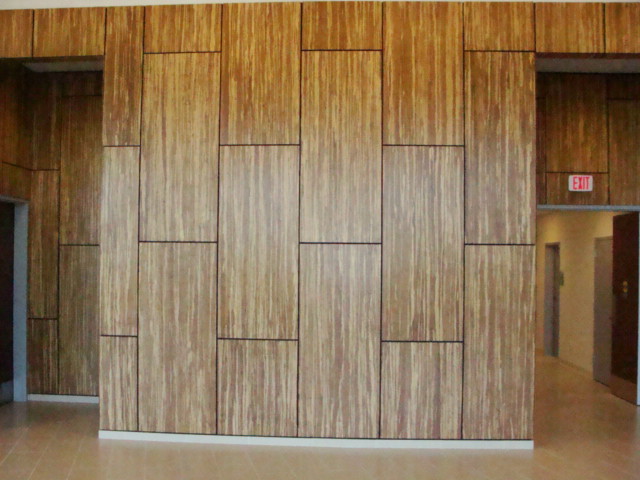
Implementation of Bamboo Wall Panels at the New KONE Center


Lamboo, Inc. is pleased to announce the implementation of its products at the new KONE center in Moline, IL. Designers chose to showcase natural materials, specifically the Lamboo® Design™ Series product, Tiger Strand panel. Contemporary design was accomplished with a natural look through the sleek and modern texture of a staggered installation. This particular Tiger Strand wall panel is the adaptation of an aesthetic pattern that accomplishes an innovative look to match the building’s other sustainable design features. “The Lamboo paneling in the lobby provides an aesthetic that you cannot find anywhere in the Quad Cities and this application reinforces the sustainable and cutting-edge image the remainder of the building showcases.” Said Bryce T. Henderson, KONE’s Chief Financial and Operating Officer.


Completed in late summer 2012, the new, mixed-use building will be a significant focal point of architecture in the Quad Cities. The KONE Centre is an eight-story, 121,000-square-feet commercial office and residential condominium building located within Moline’s Bass Street Landing. The functionally designed floor plates are approximately 15,000 square feet at each level. In his new role as Project Manager, Eric Abrams was responsible for estimating, and the coordination of the construction of the new KONE Center in Moline, IL. Commenting on the application of Lamboo Tiger Strand wall panels, Eric stated that “The Lamboo Tiger Strand panel was an excellent choice selected by the Design Architect on the project. The material was within our budget and aesthetically surpassed the expectations of the design team and property owner, it was a homerun product during our value engineering process. The team at Lamboo had excellent product knowledge and was able to assist the design team in selecting the perfect material for our wall panel application. The occupants of KONE Centre are welcomed by nearly 4,500 square-feet of the renewable material, and as the project manager, I could not be more pleased with Lamboo products.”


  For questions regarding Lamboo, Tiger Strand, or to schedule an interview please
visit our website at www.lamboo.us or contact us at info@lamboo.us 866-966-2999

“MAKING INNOVATIVE THINKING A STANDARD” – Lamboo Incorporated

Blog by: Dustin Dennison